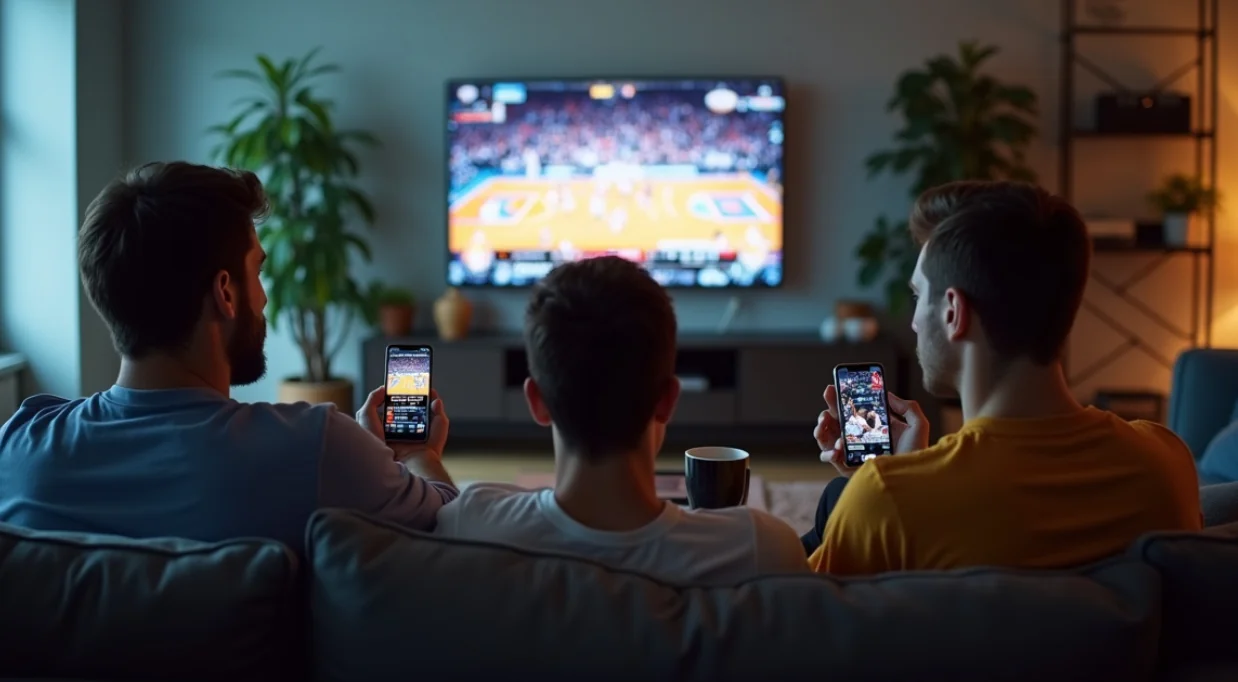
American sports fandom in 2026 looks denser, faster, and far more screen-saturated than it did even three seasons ago. The average NFL Sunday now pulls audiences across at least two devices for most viewers under forty, with the television carrying the broadcast and the phone carrying everything else: live stats, group chats, fantasy lineups, and a steady drip of in-game data points that did not exist in any meaningful way a decade ago. Major League Baseball, after years of slow ratings erosion, is enjoying a viewership rebound tied to its new-look national television package, and the NBA continues to push first-quarter audiences higher through aggressive streaming bundles. Inside this expanded media surface, fans are spending more time with sports than ever, and they are spending that time in ways the old broadcast-only model never anticipated.
One of the more telling subplots inside that expansion is the steady migration of sports-savvy American fans into casino-style gaming during the off-hours, mostly in the seven states where regulated online casino is currently legal. The cohort overlap is concrete and measurable: NFL and NBA fans aged twenty-five to forty-four, household incomes north of seventy-five thousand dollars, app-fluent, and already comfortable with quick decision-making against live information. What used to be two separate audiences now reads, in operator dashboards and in independent research from the American Gaming Association, like one continuous behavioural pattern that flexes with the sports calendar. Understanding it has become useful even for readers who have never opened a sportsbook app, because the same engagement habits are reshaping how stadiums sell tickets, how networks price ad inventory, and how leagues schedule their tentpole windows.
Readers curious to see how the off-season side of that crossover actually presents itself can browse the major operator overviews collected on the PlayUSA casino list for context on which brands run in which states and how their no-deposit offers are structured. Beyond that one quick reference, this article is squarely about US sports fans in 2026, the rhythms of the seasons they follow, the data shaping how leagues package their broadcasts, and the second-screen habits that decide which platforms keep their attention through the long stretch from one championship to the next.
Why the second-screen NFL fan is the most studied audience in 2026
No sport in America generates the data trail that the NFL does on a single Sunday, and broadcasters know it. Nielsen panel data continues to show that more than seventy percent of viewers aged twenty-one to forty-four use a phone while a game is on, with the median session involving three to five distinct apps in a typical three-hour window. The most common cluster pairs the league app with a fantasy or DFS platform and a messaging service, but the second-screen mix has expanded steadily to include short-form highlights, real-time analytics dashboards, and at the edges, transactional apps for everything from food delivery to in-game polls. For ad buyers the implication is immediate. A thirty-second linear spot now competes with a much richer attention budget, and the brands that are landing memorably are the ones that build a small, instantly understood hook into the broader second-screen flow rather than asking for the full window of attention. NFL ratings remain remarkably resilient against this fragmentation, but the share of value that the linear spot itself carries has compressed.
MLB’s audience rebound and what it tells us about modern fan attention
Baseball is the surprise audience story of the 2026 season so far. Through the first weekend in May the league averaged two point two eight million viewers per nationally telecast game, a forty-four percent jump over the comparable stretch a year earlier and the strongest such mark since 2017. Opening Day delivered records for both Netflix and NBC, and Fox is reporting a forty percent lift through April for its Saturday MLB coverage. Two threads explain most of that growth. First, the league’s restructured national rights package has spread its inventory more evenly across ESPN, Fox, NBC, and Netflix, which means that a greater share of casual viewers now stumble into a televised game without having to remember which channel carries it. Second, the on-field product has cooperated. The pitch clock continues to compress average game times into the two-hour-and-thirty-eight-minute range, which fits modern attention budgets in a way that the four-hour mid-2010s game did not. For fans who came of age treating live sports as one tab among many, MLB now feels more like a viable companion to the second-screen flow rather than a competing demand.
The NBA off-season as the laboratory of US fan engagement
If the NFL owns the autumn weekend and MLB owns the spring evening, the NBA increasingly owns the in-between hours. Its off-season has quietly become the most active stretch on the American sports content calendar, anchored by free agency, a draft cycle that now runs across two televised nights, and a Summer League broadcast that draws audiences once reserved for regular-season cable lineups. Players themselves have leaned into the shift, with personal podcasts, training-content YouTube channels, and Instagram series filling the months that older fans once treated as dead air. The result is a year-round attention surface that more closely resembles the European football model than the older American template of clean on-and-off seasons. For brands that historically used summer as a media-spend trough this is a pricing event. For the league it is a structural moat against the steady erosion of single-night appointment viewing. And for fans, it has reset expectations about what counts as basketball season, with a meaningful share of the 2026 audience treating June through September as core programming rather than recovery time.
The injury news cycle and the shape of an in-season story
American sports fans have always tracked injuries closely, but the speed at which a single update now reshapes the rest of a season has changed the way news desks work. Beat reporters file in minutes, not hours, and a single confirmed surgery can rewrite a club’s projected ceiling by the next morning. The season-ending shortstop loss for the Astros filed earlier this season is a representative example, the kind of report that changes a contender’s lineup math and ripples out into trade speculation, fantasy advice columns, and rest-of-year power rankings before the team itself has named a permanent replacement. What is striking about the modern cycle is not that injuries matter more than they used to but that the surrounding analytical layer is so much thicker. Within twenty-four hours of any meaningful update, fans can read a clubhouse-source explainer, a contract-impact breakdown, a positional depth-chart re-rank, and a fantasy-league reaction piece, all from credible voices. That dense layer of context is part of what keeps modern audiences in the season story even during quieter weeks.
Streaming bundles and the 2026 reshuffle of where fans actually watch
The most significant story in American sports media this year is not which league grew or shrank, it is where the screens themselves moved. Netflix has now carried marquee NFL, MLB, and boxing windows. Amazon Prime Video continues to anchor Thursday Night Football and has expanded its NBA In-Season Tournament coverage. Apple TV holds Friday Night Baseball and the entire MLS package. Peacock owns a meaningful slice of the Sunday Night Football inventory, and YouTube TV continues to host NFL Sunday Ticket. For the fan, this means the question of where to find a given game is more complicated than it has been at any point since the pre-cable era, and bundle-stacking is now a standard household behaviour. Surveys conducted across the spring of 2026 suggest that the median dedicated US sports household now subscribes to at least four streaming services, with the average direct-to-consumer sports spend climbing to roughly one hundred and thirty dollars a month. That figure was below seventy a year ago. The competitive pressure on linear is unmistakable, and broadcasters are responding with deeper integrated-graphics packages, more in-game analytics overlays, and faster commercial pods designed to reduce the temptation to switch tabs.
What modern viewership data says about US fan loyalty
Audience research from across the spring quietly contradicts the older idea that streaming would weaken sports fandom. Front Office Sports reported the early-2026 MLB ratings lift across new TV deals using exactly this lens, showing how a more fragmented distribution map is producing larger, not smaller, total audiences for a sport that many observers had written off. The same pattern shows up in NBA streaming numbers, where the Apple-Peacock-Amazon mix is generating a wider unique-viewer count than the older single-network arrangement ever did. The takeaway for ad buyers and rights holders is consistent. Distribution scarcity used to be the lever, but in 2026 it is distribution density that travels with the sport. Fans will follow a property across services if the product is compelling, and the long-term winners are the leagues that have negotiated genuinely multi-platform packages rather than locked themselves to a single distributor.
How parlay-trained sports thinking spills into adjacent app behaviour
One reason analysts pay attention to the sportsbook-to-casino crossover is that it tells a broader story about how US sports fans now process probability. Decades of fantasy football, daily DFS contests, and the more recent rise of legal in-app sports wagering have produced a generation of fans who are unusually comfortable thinking in expected-value terms. Industry research from the 2025 American Gaming Association tracker indicates that players who routinely build multi-leg sports parlays score noticeably higher on standard sensation-seeking and risk-tolerance scales than fans who do not. Operators in the seven dual-legal states report cross-activation rates between forty-eight and sixty-seven percent, with New Jersey at the top of the range and West Virginia at the bottom. The fan psychology underneath that ratio is not new. The same temperament that enjoys hedging the second half of a Lakers game also tends to enjoy quick-decision games that resolve immediately, particularly during the long off-season stretches when live sports content thins out. For sports media, the practical lesson is that the modern fan rarely sits idle. If the screens go quiet, attention finds its next stop on its own.

The 2026 sports calendar at a glance, and where the audiences sit
Looking at the year ahead, the rhythm of the American sports calendar has rarely been more legible. The table below summarises the major windows, the dominant audience segment, and the engagement signal each window tends to produce. It is a reasonable guide for anyone trying to plan media spend, content programming, or simply household viewing schedules across the rest of the year.
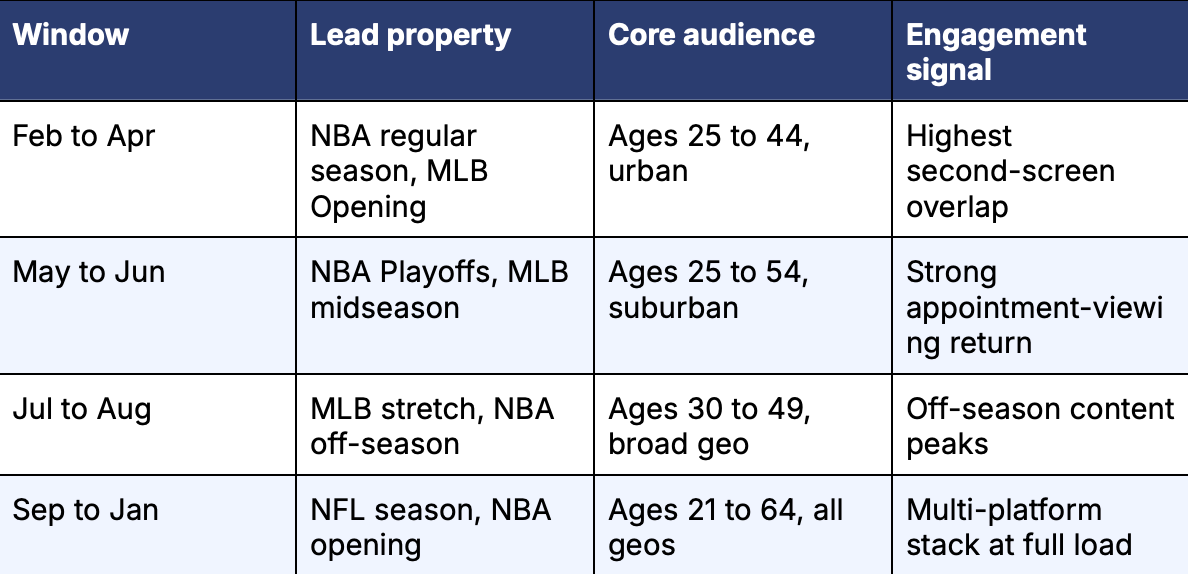
The most striking pattern in that schedule is how thoroughly the calendar has filled in. There is no real off-season anywhere in the year, and the audiences that move between properties are larger and more app-fluent than the corresponding audiences of even five seasons ago. Programming that respects that rhythm tends to perform. Programming that fights it tends to under-deliver on the expected reach numbers, regardless of how strong the on-field product is.
What the rest of 2026 likely teaches American sports media
The remainder of this calendar year carries the rare weight of multiple structurally important moments arriving close together. Super Bowl LX has already produced one of the larger linear audiences of the decade. The FIFA World Cup arrives on US soil in June with thirty-seven percent of general-population respondents telling Nielsen that their interest in soccer will rise as a direct result. The MLB postseason is set up for one of its more competitive Octobers in years, and the NBA enters the second half of its season with a cluster of franchises who have not had genuine title odds in a decade. Each of those events will sit on top of the same second-screen ecosystem described earlier, and each will be measured by the same blended metric that has quietly become the dominant currency of US sports media: total cross-platform reach across all rights-holding distributors. For fans, the practical reality is simpler. The number of compelling things to watch is greater than at any point in living memory, the cost to assemble the full slate has risen, and the tools to keep up with all of it have never been more capable. The 2026 American sports year will most likely be remembered less for any single result and more for the way it consolidated this new pattern of viewing into something that finally feels like the steady state rather than a transitional period.