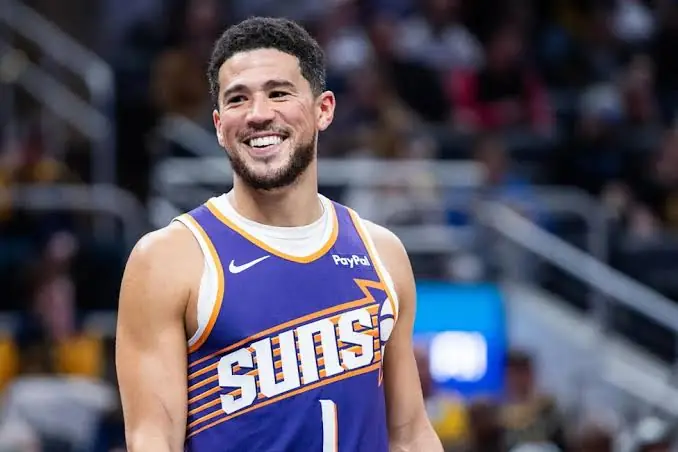
The Golden State Warriors would reportedly move immediately to pursue Devin Booker if the Phoenix Suns ever made their franchise star available, potentially offering three first-round picks and additional assets to unite him with Stephen Curry.
Warriors insider Tim Kawakami claims Golden State’s admiration for Booker extends throughout the organisation, including coach Steve Kerr.
“I think the Warriors like him too much if you ask me. But they love him. Steve loves him,” Kawakami said on the Warriors Plus/Minus podcast, according to Sports Illustrated.
“Booker loved playing for Steve. They love Devin Booker.”
Kawakami suggested Golden State would be “first in line” if Phoenix eventually responded to another disappointing season by considering a rebuild.
“I know the Warriors would be first in line saying, ‘We got three first-round picks we can give you, and what else do you want?’” he said.
The possibility is undeniably fascinating.
It is also a long way from becoming a real trade.
Phoenix has repeatedly insisted Booker will not be moved, while the four-time All-Star reinforced his commitment to the Suns by signing another long-term extension last year.
There is no indication Booker has requested a trade or that the teams have opened negotiations.
Golden State is not currently chasing an available superstar.
It is positioning itself for the possibility that Phoenix’s repeated failures eventually force an uncomfortable decision.
Warriors’ Interest Begins With Steve Kerr
The connection between Booker and Golden State is stronger than a random trade proposal.

Kerr coached Booker during the United States’ gold-medal campaign at the Paris Olympics and gained direct experience of how the Suns guard could contribute within a team containing several other several other superstars.
Booker accepted a less prominent offensive role, defended aggressively and became one of the squad’s most dependable players.
That willingness to adapt appears to have left a considerable impression upon Kerr.
Booker also played alongside Curry during the tournament, giving Golden State’s two most influential basketball figures an opportunity to evaluate his personality and game at close range.
The fit is easy to imagine.
Curry’s movement and shooting would create space for Booker to attack from the middle of the floor, while Booker could relieve the 38-year-old of the exhausting burden of generating almost every important shot.
Golden State has spent years searching for a reliable secondary scorer capable of punishing opponents when they trap Curry.
Booker would not merely satisfy that requirement.
He could become the next face of the franchise.
Booker Would Extend Golden State Beyond Curry
Most potential Warriors targets are judged by whether they can help Curry win a fifth championship.
Booker offers something more valuable.
At 29, he could strengthen Golden State immediately while remaining an elite player after Curry retires.
That combination makes him an unusually logical target for an organisation attempting to compete in two timelines.
The Warriors need another high-level creator now, particularly with Jimmy Butler recovering from a serious knee injury and the veteran core approaching the end of its championship window.
They also lack an established successor capable of carrying the franchise into its next era.
Booker could potentially solve both problems.
He is an accomplished three-level scorer, a capable playmaker and an experienced postseason performer who helped Phoenix reach the 2021 NBA Finals.
Unlike a veteran acquired solely for one final championship attempt, Booker would retain significant long-term value.
Golden State could justify surrendering multiple first-round selections because it would not be buying only the remainder of Curry’s career.
It would be acquiring a player capable of leading the organisation for several additional seasons.
Phoenix Has Publicly Closed the Door
The biggest problem with the idea is straightforward.
The Suns do not want to trade Booker.
Phoenix owner Mat Ishbia has repeatedly described him as the untouchable centrepiece of the franchise.
“Devin Booker is our franchise player,” Ishbia said during his end-of-season press conference.
“I love Devin Booker. Devin Booker loves being here. Our coach loves Devin Booker. Our GM loves Devin Booker. Devin Booker is going to be here.”
Ishbia went even further by predicting Booker would eventually lead the Suns to a championship.
Those comments make the organisation’s public position unmistakable.
Phoenix intends to construct its next contender around Booker rather than use him to begin another rebuild.
His recent extension supports that approach.
Booker chose to secure his long-term future with the Suns despite the franchise enduring several disappointing seasons following its run to the Finals.
Golden State cannot create an opening merely by admiring him or collecting draft capital.
Either Phoenix must change its position or Booker must request a move.
Neither outcome appears imminent.
Suns’ Asset Problem Could Eventually Change Everything
Kawakami’s argument is based upon what could happen if Phoenix’s attempt to rebuild around Booker fails.
The Suns have already surrendered substantial draft capital through previous trades designed to create an immediate contender.
That approach produced a star-heavy roster but limited the organisation’s ability to refresh its supporting cast with inexpensive young talent.
If Phoenix struggles again, the front office could face a difficult question.
How can the Suns complete a meaningful rebuild without controlling enough valuable draft selections?
Trading Booker would offer the fastest—and most painful—solution.
A package containing three Golden State first-round picks, further draft compensation and young players could restore much of the flexibility Phoenix sacrificed during its previous championship chase.
That does not mean the Suns should trade Booker after one poor season.
Franchise players of his calibre are far harder to find than future draft selections, and there is no guarantee any pick would produce someone close to his level.
The calculation could change if Booker became frustrated and requested a departure.
Phoenix would then need to choose between retaining an unhappy superstar or creating a bidding war capable of accelerating a complete rebuild.
Golden State would undoubtedly enter that contest.
It would not be the only team calling.
Warriors Would Need More Than Three Picks
Kawakami’s reference to three first-round selections illustrates Golden State’s level of interest rather than outlining a complete trade proposal.
A legal deal would require the Warriors to match Booker’s substantial salary.
That means at least one significant Golden State contract would need to move in the opposite direction, potentially alongside young players and draft compensation.
Phoenix would also demand quality, not simply quantity.
Three first-round picks sound attractive, but their actual value would depend upon the years involved and the protections attached.
Selections scheduled while Booker remained in his prime could fall late in the first round if he kept Golden State competitive.
Picks extending beyond the Curry era would be considerably more valuable because they could land after the Warriors’ current core had disappeared.
Phoenix would likely seek swaps, unprotected selections and at least one young player with genuine upside.
The Suns would have no reason to accept an ordinary package when almost every ambitious franchise would investigate Booker’s availability.
Golden State may be first in line.
It would still need to win the auction.
Curry’s Age Makes the Timing Difficult
The most appealing version of the trade would place Booker beside Curry while the greatest shooter in NBA history remains capable of playing at an elite level.
Time is working against that possibility.
Curry is already 38 and entering the final season of his current contract.
He has publicly declared that he wants to spend the remainder of his career with Golden State, but even another extension cannot guarantee his physical prime will continue.
If Phoenix refuses to reconsider Booker’s future for another two seasons, the opportunity to create a Curry-Booker backcourt could disappear.
That is why Kawakami’s comments carry urgency despite the absence of an available trade.
Golden State needs to remain ready to act immediately if circumstances change.
The Warriors cannot spend months debating whether three first-round picks are too expensive while rival teams submit serious offers.
A player such as Booker rarely reaches the market.
If he does, hesitation would probably eliminate Golden State before negotiations properly began.
Booker Could Give Curry His Final Championship Partner
Booker would immediately transform the Warriors’ offence.
Opponents could no longer devote overwhelming defensive attention to Curry without leaving another elite scorer in favourable coverage.
Booker can create from isolation, operate as a pick-and-roll ball-handler and attack defenders scrambling to recover after chasing Curry through multiple screens.
Kerr could also use Curry away from the ball more frequently without asking a limited creator to organise the possession.
The partnership would create defensive concerns.
Neither Booker nor Curry should be expected to consistently guard the opposition’s most dangerous perimeter scorer, making the remainder of Golden State’s lineup extremely important.
The Warriors would need enough size, athleticism and defensive versatility around them to prevent the backcourt from becoming a target during the playoffs.
Booker’s Olympic performances suggest he can embrace a more demanding defensive role when surrounded by elite talent.
Maintaining that commitment across an 82-game season would be a different challenge.
Golden State would accept those concerns for the offensive ceiling the partnership could create.
Interest Is Real but the Trade Is Not
Kawakami’s report should be understood accurately.
He is not claiming Golden State and Phoenix have discussed a Booker trade.
He is describing how aggressively the Warriors would respond if the Suns ever reversed their position.
That distinction matters.
Booker remains committed to Phoenix, holds a long-term contract and has been publicly declared unavailable by ownership.
A disappointing beginning to the season would generate speculation, but it would not automatically place him upon the trade market.
Golden State must also decide how aggressively it wants to use its future picks while balancing Curry’s remaining championship years against the organisation’s long-term future.
The Warriors have already been linked with several enormous moves as they search for the right bridge between eras.
One hypothetical proposal even suggested they should trade Curry for Dylan Harper and De’Aaron Fox, although Curry’s loyalty pledge made that scenario exceptionally difficult to justify.
Booker represents the opposite strategy.
Instead of moving Curry to begin the future, Golden State would acquire a younger star capable of helping him now and replacing him later.
It may be the perfect plan.
Unfortunately for the Warriors, it depends upon Phoenix making the one decision it has repeatedly promised never to make.