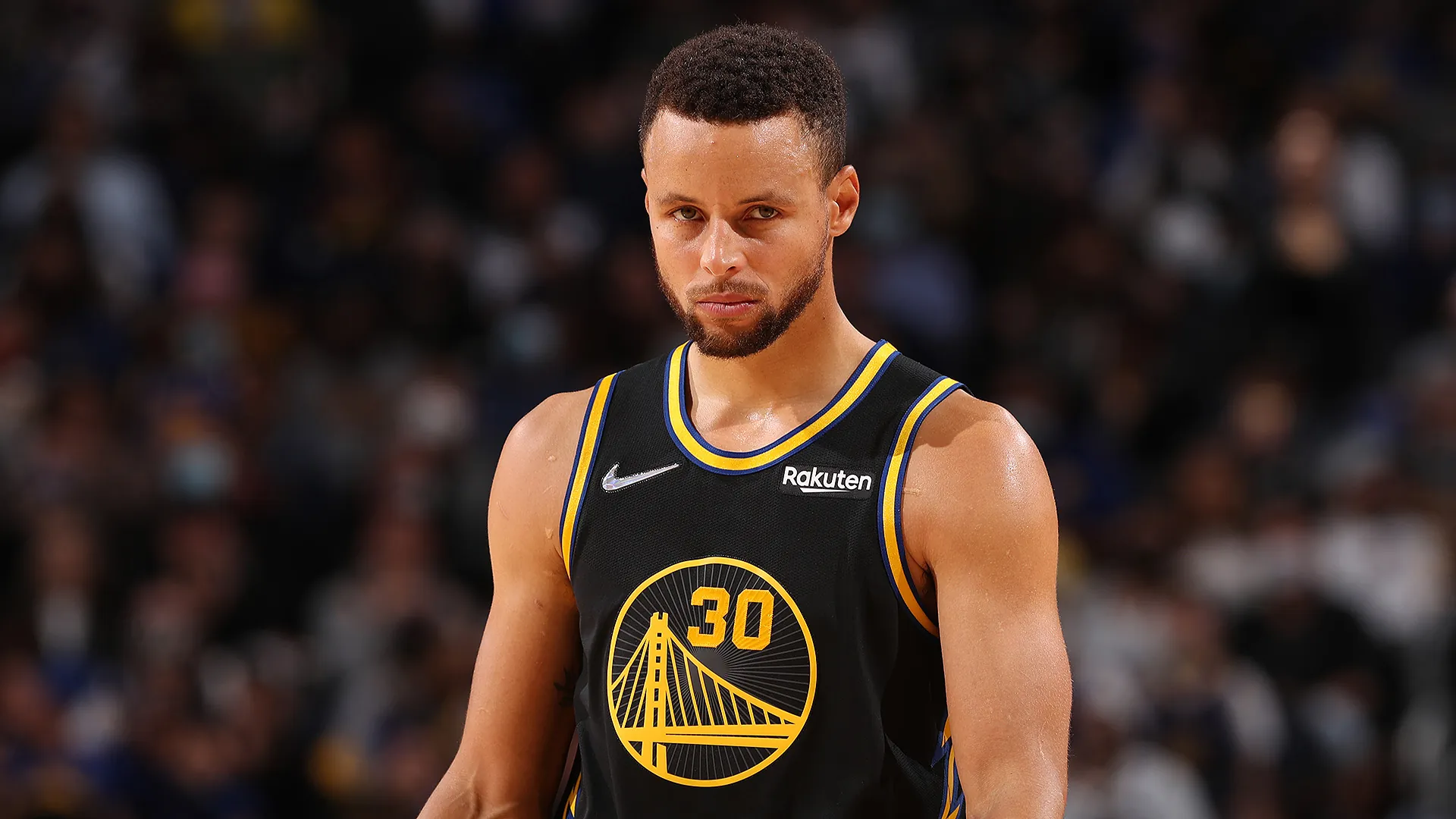
Stephen Curry has emphatically rejected suggestions he could chase a fifth championship elsewhere, declaring he expects to spend the remainder of his NBA career with the Golden State Warriors.
The 38-year-old is entering the final season of his current contract and recently became eligible for a two-year extension reportedly worth US$136.7 million.
That uncertainty had encouraged hypothetical trades and suggestions Curry could eventually join a younger contender if Golden State remained outside the championship picture.
Curry has now made his position unmistakably clear.
“There’s no question I want to be here the rest of my career, and I’m pretty sure that’s going to happen,” Curry told NBC Sports Bay Area.
Curry Refuses to Turn Contract Into a Distraction
Curry will earn approximately US$62.6 million during the 2026–27 season before potentially becoming an unrestricted free agent.
However, he indicated that neither he nor the Warriors were treating the absence of an extension as evidence of a disagreement.
The two-time MVP expects negotiations to be resolved at the appropriate time and does not want them distracting from Golden State’s preparation for the new season.
That does not necessarily mean an agreement is imminent.
There may be legitimate financial reasons for both parties to wait, particularly when Golden State will have several enormous contracts expiring at the same time.
The important development is that Curry has separated the timing of the paperwork from his commitment to the organisation.
He is not using the extension as leverage to threaten a departure. He is publicly predicting that he will remain a Warrior until he retires.
Warriors Can Create Enormous 2027 Flexibility
Curry, Jimmy Butler and Draymond Green are all entering the final seasons of their current agreements.

According to NBC Sports, the three veterans will earn a combined US$147 million in 2026–27.
Allowing those contracts to expire before restructuring the roster could provide Golden State with considerably greater flexibility during the 2027 offseason.
That does not mean the Warriors intend to lose all three players.
Golden State could wait to finalise Curry’s extension while retaining the ability to pursue another star, reshape the supporting cast or negotiate new agreements with its veteran core.
Signing Curry immediately would eliminate the inevitable speculation but could make those calculations more complicated.
The risk is that every month without an agreement will generate new trade proposals, regardless of how frequently Curry insists he wants to remain.
Any significant losing streak or front-office disagreement would immediately be interpreted as evidence that his position could change.
Curry’s statement should end the serious argument about his intentions.
It will not end the rumours until his signature is attached to another Warriors contract.
Golden State Still Owes Curry a Competitive Roster
Curry’s loyalty removes one potential crisis but creates another responsibility for the Warriors.
The organisation cannot use his desire to remain as an excuse for failing to build a genuine contender around him.
Golden State finished the 2025–26 season with a 37–45 record and was eliminated in the Play-In Tournament. Curry remained an elite scorer when available, averaging 26.6 points in 43 appearances while making 39.3 per cent of his three-point attempts.
His ability is not the primary problem.
The Warriors have struggled to provide enough reliable shot creation, size and availability around their franchise player.
Butler is recovering from the ACL injury that ended his season, while Moses Moody is also expected to miss a substantial portion of the new campaign following a serious knee injury.
That places enormous early pressure upon Curry.
Golden State cannot reasonably ask a 38-year-old guard to carry an undermanned offence for several months and still expect him to remain healthy for a potential postseason run.
The loyalty pledge therefore does not absolve the front office.
It gives Golden State more time to find the right move, but the remaining championship window is still closing.
Trade Proposals Were Never Particularly Realistic
Curry’s expiring contract produced several dramatic hypothetical trades during the offseason.
One proposal suggested Golden State should send him to San Antonio for a package headlined by Dylan Harper and De’Aaron Fox, allowing Curry to join Victor Wembanyama while giving the Warriors a new franchise cornerstone.
There was no indication the teams had held negotiations, and Curry’s comments make that scenario even less credible.
The Warriors would need to decide that their greatest player was no longer central to their future. Curry would then need to abandon his stated desire to retire with the only NBA organisation he has represented.
Neither condition appears close to being met.
A trade could theoretically become possible if Golden State collapsed and Curry unexpectedly changed his position.
It should not be presented as an active possibility merely because another team could assemble an attractive package.
Curry has effectively told the league not to bother waiting for him.
Curry’s Legacy Is Permanently Connected to Golden State
Few players have transformed an organisation as completely as Curry.
The Warriors selected him with the seventh pick of the 2009 NBA Draft when the franchise had made the playoffs only once across the previous 15 seasons.
He subsequently became the central figure in four championship teams, won consecutive MVP awards and changed how basketball is played through his shooting range, movement and willingness to attempt shots that were once considered irresponsible.
Curry also became the NBA’s career leader in three-pointers and delivered his long-awaited Finals MVP performance during Golden State’s 2022 championship victory over Boston.
Leaving now would not destroy that legacy.
Hakeem Olajuwon finished with Toronto, Michael Jordan returned with Washington and Patrick Ewing ended his career away from New York. Late-career moves do not erase decades of achievement.
Curry clearly wants a different ending.
He has an opportunity to join the small group of modern superstars who spent their entire careers with one organisation.
Warriors Must Decide How Much Loyalty Is Worth
Golden State general manager Mike Dunleavy has already indicated the organisation wants to retain Curry regardless of the financial cost.
The proposed two-year extension would reflect that commitment.
Curry would be approaching his 41st birthday by the end of the agreement, making any deal worth more than US$136 million an extraordinary investment in an aging guard.
Ordinarily, the Warriors would need to consider whether such a contract could become an obstacle as his performance declines.
Curry is not an ordinary case.
His value extends beyond points and assists. He remains the foundation of Golden State’s identity, commercial appeal and ability to attract other players.
The franchise also owes much of its modern valuation and global popularity to the dynasty he created.
Paying Curry through the final years of his career may not represent perfect salary-cap efficiency. It would recognise that some relationships are worth preserving even when the spreadsheet becomes uncomfortable.
Curry Has Removed Golden State’s Biggest Excuse
The Warriors no longer need to wonder whether Curry is considering a departure.
He wants to finish his career in Golden State and expects the organisation to make that possible.
The remaining question is whether the franchise can give him something more meaningful than a ceremonial farewell tour.
Curry is still good enough to influence a championship race. He should not be forced to spend his final elite seasons fighting merely to reach the Play-In Tournament.
His declaration represents the ultimate loyalty pledge.
Golden State must now prove that loyalty still works both ways.