
There is a pattern Australian sports followers will find familiar playing out across Canada right now. Money that people used to spend at the track, the club, or the corner venue is moving onto phones and laptops, and governments are racing to put a regulated frame around it before the unregulated version swallows the market. Australia went through its own version of this shift years ago, with mixed results, which is exactly why the Canadian story is worth watching from the other side of the world.
Canada is not doing this all at once. It is doing it province by province, and the two that have moved are large enough to signal where the whole country is heading. Ontario opened a regulated online gambling market in 2022 and has watched it grow into one of the biggest in North America. Alberta followed in the middle of 2026. Between them they show a leisure economy shifting online in real time, and the numbers are the kind that make an Australian reader nod in recognition.
Before going further, a note on a category that sits between the free-to-play world and the cash market, because North American readers ask about it constantly. In the United States, sweepstakes casinos let people play familiar-looking games using promotional currency rather than direct wagers, and the rules differ from state to state. For anyone trying to understand how that dual-currency model works and where it is allowed, Bonus.com’s sweepstakes casino guidance breaks down the mechanics and the shifting legal map in plain terms. With that reference point set, the more useful comparison for an Australian audience is what regulated Canada is building and how it echoes what Australia already lived through.
Ontario Built the Blueprint Canada Is Copying
Ontario is the case study everyone points to. Its regulated online market launched in April 2022, run on a conduct-and-manage model where licensed private operators offer casino games and sports betting under provincial oversight. Four years in, the results are large enough to have settled the argument about whether regulation could pull players off the grey market.
By 2025 the province reported figures that put it among the biggest regulated online markets on the continent. Operators handled tens of billions of dollars in wagers across the year, gross gaming revenue ran into the billions, and cumulative revenue since launch passed the ten-billion-dollar mark. The province’s twenty percent tax on that revenue turned into hundreds of millions of dollars flowing to public coffers annually, with cumulative tax receipts since launch measured in the billions. The official reporting from iGaming Ontario lays out the year-over-year growth behind those headline numbers.
The number that matters most for the policy debate is not the revenue, though. It is the share of players who moved to regulated sites. Surveys tied to the market found that a large majority of Ontario online gamblers, well over eighty percent, were using licensed platforms rather than offshore ones. That figure is the whole argument for regulation in one statistic. The market did not create demand out of nothing. It captured demand that already existed and pulled it somewhere the province could see it, tax it, and set rules around it.
Alberta Joins, and the Model Spreads West
For most of Ontario’s run it stood alone, the only Canadian province with a fully open, regulated online market of this kind. That changed in 2026. Alberta launched its own regulated online gambling market on July 13, becoming the second province to open the door to private operators under a provincial framework.
Alberta’s setup splits the work between two bodies. The provincial gaming regulator oversees the rules, while a separate corporation manages the market’s commercial operation, a structure that borrows from the Ontario approach while keeping its own regional character. The province spent well over a year building the legal machinery before flipping the switch, and its published strategy documents lay out the reasoning, which readers can review through the Alberta government’s iGaming pages.
Two provinces do not make a national market, but they establish a direction. Ontario proved the model works at scale and generates real public revenue. Alberta proved another province would follow. For anyone watching Canada’s leisure spend, the signal is clear enough: the shift online is not a trend that might reverse, it is a structural change that regulators have decided to manage rather than resist. The open question is only how many more provinces sign on, and how fast.
The rest of Canada is not standing entirely still. Most other provinces still route online play through their own government-run platforms rather than opening licensed private competition, which is a middle position between Ontario’s open market and an outright ban. Whether those provinces move to the Ontario style of open licensing will likely depend on how the tax numbers and harm data from Ontario and Alberta read over the next couple of years. A big, clean revenue line with manageable harm figures would make the case for the rest of the country. A messier result would slow it down.
Why Australians Recognize This Story
An Australian reader looking at Canada is looking at a country a few steps behind on a road Australia already traveled. Australia is one of the most heavily gambling-exposed populations in the world, and the numbers behind that reputation are stark. Research from the Australian Gambling Research Centre, part of a national institute, found that around two-thirds of Australian adults gambled at least once in the past year, and that roughly one in seven experienced some form of gambling-related harm, both figures up meaningfully since 2019.

The scale of money involved is enormous by any measure. Estimates of Australia’s annual gambling losses run into the tens of billions of dollars, consistently reported as the highest per-capita losses of any country. Electronic gaming machines, the pokies, account for a large share of that total. The national research body’s gambling prevalence findings document both the participation rates and the harm, and public-health tracking through bodies like the Australian Institute of Health and Welfare adds to the picture.
The recognition, then, is not about Canada catching up to Australian spending levels. It is about the sequence. A society sees leisure money pour into gambling, watches it spread from venues to screens, and then argues about how to regulate what is already happening. Australia had that argument, wrote its rules, and is still living with the consequences. Canada is having the same argument now, with the advantage of watching how it played out elsewhere first.
The Australian research also carries a warning that Canadian regulators would be wise to read. The same national study found that participation and reported harm both climbed between 2019 and the most recent survey, not fell, even though Australia has run public-awareness campaigns and tightened advertising rules across that period. Community attitudes have hardened alongside the numbers, with large majorities telling researchers there are too many opportunities to gamble and that the activity should be discouraged. A regulated market can capture demand and revenue, but it does not, on its own, bend the harm curve downward. That is the uncomfortable part of the Australian experience, and it is the part most easily lost in the excitement over tax receipts.
The One Rule That Split the Two Countries
Here is where the Australian and Canadian paths diverge in a way that shapes everything else. Australia’s federal Interactive Gambling Act, passed in 2001 and administered by the national communications regulator, prohibits online casino games and online slots for Australian residents. Online sports betting is legal and widely advertised, but online pokies and casino tables are not. The government drew a line: you can bet on the footy from your couch, but you cannot spin an online slot from it.
Canada’s provinces drew the line in a different place. Ontario and Alberta chose to license online casino games and slots, not just sports betting, bringing the whole category inside a regulated frame. The reasoning is the mirror image of Australia’s. Rather than ban the product and hope demand fades, they legalized it and pulled the players onto licensed sites they could monitor and tax. The text of Australia’s Interactive Gambling Act sets out the prohibition that Canada declined to copy.
The consequence of Australia’s approach is the part Canadians should study closely. Because online casino play is banned rather than regulated, a meaningful amount of that demand did not disappear. It routed to offshore operators licensed in places like Curacao, outside Australian oversight and outside Australian tax. Australia banned the product and kept some of the harm while losing the revenue and the control. Ontario’s high share of players on regulated sites is the direct counterpoint. Same demand, opposite policy, very different outcome.
Where Sweepstakes Casinos Fit the Picture
The American sweepstakes model is a third path worth understanding, because it sits outside both the Canadian and Australian frameworks. Instead of taking direct wagers, a sweepstakes casino uses two kinds of virtual currency. One is bought or given away and carries no cash value, used purely for play. The other is generally received for free, through promotions or as a bonus, and can be redeemed for prizes. The no-purchase-necessary structure is what places these platforms under sweepstakes law rather than gambling law in much of the United States.
That legal footing is not settled, and it is moving fast. Sweepstakes casinos have been accessible across most US states, but a growing list of states has moved to ban or restrict the dual-currency model, with several passing explicit prohibitions in 2025 and 2026. The category grew quickly precisely because it let people play familiar games without a deposit, and that same growth drew the regulatory attention now reshaping it. The map of where it is allowed changes state by state, which is why a current reference is more useful than any fixed list.
For an Australian audience, the sweepstakes model reads as a clever answer to exactly the problem the Interactive Gambling Act created. Where Australia banned online casino play outright and pushed demand offshore, the US sweepstakes category found a legal structure that delivers a similar experience without meeting the definition of gambling in many places. Whether that structure holds up is the open question, and the wave of state-level bans suggests regulators are skeptical. It is one more variation on the same theme: leisure spend wants to move online, and every jurisdiction is improvising a different frame to catch it.
What the Numbers Say Side by Side
Laying the three approaches next to each other makes the differences concrete. The table below compares how Canada’s regulated provinces, Australia’s federal rules, and the US sweepstakes category treat online casino-style play.
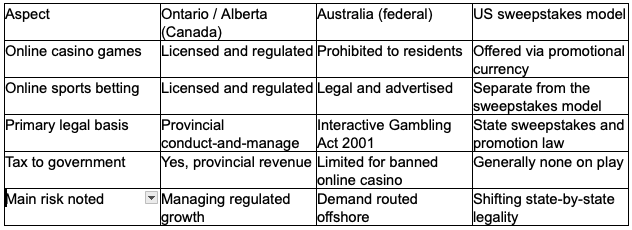
Read across the rows and the trade-offs come into focus. Canada’s model generates public revenue and keeps players visible, at the cost of endorsing the product. Australia’s model refuses to endorse online casino play, at the cost of pushing it offshore. The US sweepstakes approach threads a legal needle that is now fraying under state-level pushback. No jurisdiction has found a frame that pleases everyone, and each is watching the others.
What Canada’s Next Few Years Might Look Like
If Ontario and Alberta are the leading edge, the reasonable guess is that more provinces will study those results and decide whether to follow. The pull is obvious. A regulated market delivers tax revenue, gives regulators visibility into a market that otherwise runs offshore, and lets a province set consumer-protection rules rather than leaving players to unlicensed sites. Those incentives do not weaken over time, they compound as the early provinces publish their numbers.
The caution Australia offers is that regulation is not a finish line. Australia legalized online sports betting and still wrestles with advertising volume, harm rates that have climbed rather than fallen, and a black market for the products it banned. Opening a regulated market solves the visibility and revenue problem. It does not automatically solve the harm problem, and it can even raise it if convenience makes play easier. Canada’s provinces are inheriting both sides of that lesson.
For sports followers on either continent, the practical point is the same. The move from venue to screen is well underway, it is not reversing, and the only real variable is how each jurisdiction chooses to frame it. Australia framed it one way, Canada is framing it another, and the United States is improvising a third. Watching how those frames hold up is the closest thing to a preview of where any given market goes next.
Whatever the frame, the personal rule does not change. Online play of any kind is adult entertainment, restricted to those of legal age in their jurisdiction, best kept to money a person is content to lose. In Australia the free Gambling Help Online service is a call or click away for anyone who wants it, and Canadian provinces run their own confidential support lines for the same purpose.
Frequently Asked Questions
When did Canada’s regulated online gambling markets launch?
Ontario opened its regulated online gambling market in April 2022, using a model where licensed private operators offer casino games and sports betting under provincial oversight. Alberta became the second province to launch a regulated online market, going live on July 13, 2026. Other Canadian provinces have not yet opened equivalent open-licensing markets.
Why can’t Australians legally play online slots?
Australia’s federal Interactive Gambling Act, passed in 2001, prohibits online casino games and online slots, known locally as pokies, for Australian residents. Online sports betting is legal and heavily advertised, but online casino products are not. As a result, some demand for online slots has routed to offshore operators outside Australian regulation and taxation.
How is the Canadian approach different from the Australian one?
The key difference is that Canada’s regulated provinces licensed online casino games and slots, while Australia banned them at the federal level. Ontario and Alberta chose to regulate and tax the product to keep players on monitored sites, whereas Australia prohibited it, which pushed some players toward unlicensed offshore platforms. The two countries reached opposite policy choices on the same demand.
What is a sweepstakes casino?
A sweepstakes casino is a mostly US model that uses two virtual currencies instead of direct wagers. One currency is for play only and has no cash value, while the other can typically be obtained for free and redeemed for prizes. The no-purchase-necessary structure places these platforms under sweepstakes law rather than gambling law in many states, though a growing number of states have moved to restrict or ban them.
Does regulating online gambling reduce gambling harm?
Regulation improves visibility, revenue, and consumer-protection rules, and it can pull players away from unlicensed sites, as Ontario’s high share of regulated play shows. It does not automatically reduce harm, however. Australia’s experience with legal online sports betting shows that harm rates can rise even in a regulated market, which is why consumer protections and support services remain important alongside licensing.