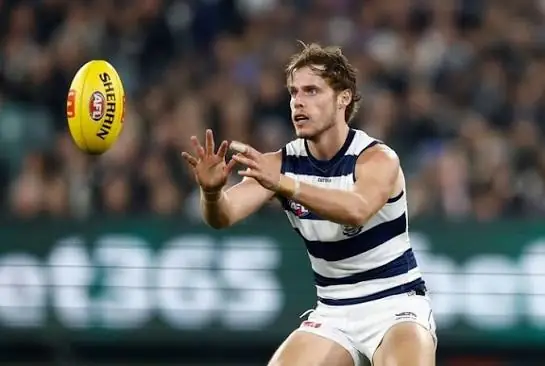
Geelong has been fined $140,000 for failing to disclose the controversial concussion agreement signed by Jake Kolodjashnij, although an independent review found the club did not coerce the defender or deliberately conceal the document.
The AFL imposed a new $100,000 sanction after James Peters KC found Geelong entered an unauthorised variation to Kolodjashnij’s playing contract and failed to lodge it with the league and AFL Players’ Association.
A previously suspended $40,000 penalty relating to a separate player-contracting breach was also activated, taking the total punishment to $140,000.
The money will be paid into the AFL and AFLPA Players’ Injury and Support Fund.
What Geelong Was Actually Punished For
The investigation established that the agreement amounted to a variation of Kolodjashnij’s standard playing contract.
Under AFL rules, that document had to be submitted to both the league and players’ association.
Geelong failed to do so.
“The review found Geelong breached AFL Rules by entering into an unauthorised variation to a player’s contract and failing to lodge that document with the AFL and AFLPA,” AFL commissioner Paul Bassat said in the league’s official findings.
“While the review found no intention to conceal the document or deceive the AFL or AFLPA, the Commission determined the rules were breached and that a significant sanction was warranted.”
That distinction is important.
Geelong was not found to have deliberately hidden a medically unfit player or forced Kolodjashnij to sign away his rights so he could continue playing.
The sanction was imposed because the club created an unauthorised contractual arrangement and did not lodge the completed document through the required process.
Independent Review Clears Club of Coercion
Peters found Geelong gave careful and detailed consideration to the risks associated with Kolodjashnij continuing his career.

The club consulted doctors, concussion specialists, lawyers, insurers, AFL representatives, Kolodjashnij, his family and his management.
The investigation found no intention to deceive the AFL or AFLPA and concluded Kolodjashnij was not coerced into signing the document.
It also made no finding of inappropriate or improper conduct warranting further punishment against Geelong or any AFL representative.
The league had previously confirmed the waiver was not used to return a medically unfit player to competition.
Kolodjashnij underwent the AFL’s independent concussion-panel process and was cleared to continue playing before signing the agreement.
Those findings directly contradict any suggestion that Geelong ignored a medical direction to retire him.
However, they do not make the waiver appropriate.
Waiver Attempted to Shift Future Risk Onto Player
The document was created in 2024 after Kolodjashnij experienced several concussions and received an uncertain initial outcome from the AFL’s independent panel.
It sought to have the defender acknowledge the risks of continuing his career and accept legal responsibility for potential future brain trauma.
The waiver was designed to reduce the future legal exposure of Geelong and members of its medical team.
Even former Geelong president Craig Drummond, who led the club when the agreement was executed, has accepted that its wording exceeded what was appropriate.
“Regardless of the player’s agreement, the club went too far in adding a waiver into an informed consent document,” Drummond previously said.
The clause could not override statutory workplace health and safety protections, but that does not remove the ethical concern created when an employer asks an athlete to assume future risks involving brain health.
Genuine informed consent is important in contact sport.
Attempting to transfer legal responsibility for future neurological damage is something different.
Geelong Says Failure Was an Oversight
Geelong accepted the findings and acknowledged the agreement should have been lodged.
“We accept in hindsight the letter constituted a variation of Jake’s playing contract and that it should have been lodged with the AFL and AFLPA,” president Grant McCabe said.
“We have taken responsibility for the error publicly and have been fully transparent and accountable through the independent process.
“Our focus remains on continuing to support Jake and his family.”
The Cats have consistently maintained that Kolodjashnij’s welfare was central to their decision-making.
“The club worked extensively with experts in concussion, medicine, law, risk and insurance,” Geelong said.
“That included experts within the club, the AFL, Jake, his family and his representative as well as engaging heavily with the AFL and the club’s insurers.
“The process was thorough and considered.”
The investigation accepted there was no deliberate concealment, describing the failure to lodge the letter as an oversight.
However, calling it an administrative error risks understating its significance.
A document changing a player’s future legal rights—particularly one involving concussion—cannot be treated like ordinary paperwork.
Drummond Recused Himself and Apologised
The case created a significant governance issue because Drummond was Geelong’s president when the document was signed in February 2024.
He became chair of the AFL Commission in 2026, placing him at the head of the body responsible for deciding Geelong’s punishment.
Drummond removed himself from all deliberations and did not participate in the Commission’s consideration of the review.
“I acknowledge and accept the review findings that the document should have been lodged by the club with the AFL, for which as president at the time I apologise,” he said.
“As the chair of the AFL, I am committed to a better process to support our clubs, players and officials as we respond to the complex challenges of head trauma and concussion in our game.”
His recusal was necessary.
Appointing Peters to conduct the review also gave the process greater independence, although the AFL Commission ultimately accepted the findings and imposed the punishment.
AFLPA Maintains Kolodjashnij Should Never Have Been Asked
The players’ association remains strongly opposed to the agreement despite the findings concerning Geelong’s intentions.
“Jake’s wellbeing remains a priority for the AFLPA and we continue to fully support him,” AFLPA chief executive James Gallagher said.
“Jake should never have been put in this position.
“Head trauma is the biggest issue facing the game and the health and safety of our members must be the priority at all times.”
The AFLPA believed the letter was inconsistent with the collective bargaining agreement and standard player contract.
That position helps explain why failing to lodge it was so serious.
Formal submission would have given the players’ association an opportunity to scrutinise the clause, object to its inclusion and protect Kolodjashnij’s contractual rights before the agreement took effect.
Geelong’s failure prevented that oversight.
Kolodjashnij Has Not Been Found Medically Unfit
Kolodjashnij has not played since the waiver became public, but his absence should not be described as evidence that he has suffered another concussion or been medically retired.
He returned to individual training ahead of Geelong’s finals campaign, with no confirmed timetable for his next match.
The 2022 premiership defender previously expressed anger that his confidential medical circumstances had entered the public domain.
“I participated fully in the AFL’s independent concussion panel process, respected its independence and was comfortable with the outcome,” Kolodjashnij said.
“What disappoints me most is that my private medical information has been made public.”
Kolodjashnij has played 35 AFL matches since signing the document and remains contracted through the end of 2026.
Any decision surrounding his return must be based upon current independent medical advice rather than public pressure created by the investigation.
AFL Launches Broader Concussion Review
The league and AFLPA will now jointly examine whether the protections available to players, clubs and officials remain adequate.
The review will consider:
- Commercial insurance protection for players and officials.
- Expanding the Injury and Support Fund for current and former players.
- Clearer protocols following AFL Concussion Panel decisions.
- The responsibilities carried by players, clubs and medical professionals.
- Greater education regarding head-trauma research and risks.
- Improvements to concussion data collection.
AFL chief executive Andrew Dillon said the case demonstrated the legal and medical complexity confronting all contact sports.
The wider review is a more important outcome than the fine alone.
Geelong can pay $140,000 without suffering any meaningful football consequence. Clear rules preventing clubs from using similar waivers would provide substantially greater protection.
Fine Settles the Rules Breach, Not the Ethical Debate
The investigation produced several findings that must be reported together.
Geelong breached AFL rules.
The club should have lodged the agreement.
Kolodjashnij was not coerced.
There was no intention to deceive the AFL or AFLPA.
The waiver was not used to field a player who had been declared medically unfit.
Those findings clear Geelong of the most serious accusations surrounding the case, but they do not justify the document itself.
A football club should never place a player in a position where continuing his career appears connected to accepting greater personal responsibility for future brain damage.
The $140,000 sanction closes the disciplinary process.
The more difficult question—how the AFL protects players who understand the danger but still want to keep playing—remains unresolved.