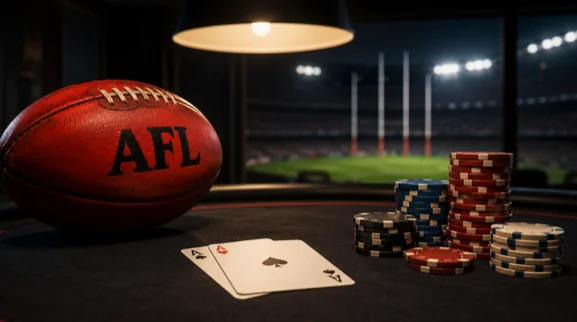
AFL personalities are familiar faces at golf days, fundraising lunches, and exhibition matches. A poker table creates a different kind of sporting appearance. The contest is contained, spectators can follow who remains, and former players and club figures can compete without the need for elite physical performance. That combination helps explain why poker events attract people from Australian football circles: the format offers recognisable competition while leaving room for conversation, charity, and personality.
The connection became especially visible in Melbourne in April 2026, with a game that included former Geelong forward Tom Hawkins, St Kilda president Andrew Bassat, and former AFL player Campbell Brown. Bassat defeated Hawkins at the end of the event, while $25,000 was donated to Street Side Medics. The result mattered, but the wider appeal came from placing familiar sporting figures inside a contest that remained competitive and social.
A Different Kind of Sporting Appearance
At a charity poker table, an AFL figure may be the reason cameras gather before play begins, but attention soon shifts to the contest. The dealer moves from seat to seat, chip stacks rise or thin, and each decision changes what remains possible in the next hand. Conversation and fundraising continue around the table, yet the shrinking field gives the event a clear direction. The tension comes from watching familiar names make choices while part of the situation remains hidden.
That rhythm is familiar to Australian recreational players during sessions at Ignition Australia. Each hand begins with private cards, a fixed order of action, and only partial knowledge of what the other players hold. Position changes from deal to deal, previous actions narrow the likely possibilities, and one hand ends before the next creates a fresh set of decisions. A sporting reputation may attract attention at the start, but it doesn’t have much impact once the game is underway.
A former player usually seen reacting within seconds must now sit through pauses, watch how others commit their chips, and decide when not to act. The quieter format exposes habits that rarely appear in match footage: patience after a setback, restraint with a marginal hand, and the ability to continue without certainty. The public name remains part of the occasion, but the table reveals a different side of the competitor.
Why Tournaments Work for Public Figures
A tournament supplies a simple public story. There is a starting field, a shrinking group, and an eventual winner. Someone unfamiliar with detailed poker strategy can still understand elimination, a comeback, or a final confrontation between two remaining players. That clarity matters when much of the audience knows the sporting names better than the cards.
The structure also creates natural pauses. A football appearance usually depends on continuous physical action, while a poker event allows conversation between hands and movement around the room as the game unfolds. Organisers can combine competition with fundraising, hospitality, and public interaction without stopping the event from producing a result. The table is therefore useful as an event format rather than decoration around a celebrity guest list.
Competition Does Not Guarantee Skill Transfers
The temptation is to explain every athlete’s interest through transferable qualities, such as discipline, pressure management, or competitiveness. Those traits may help someone settle into an event, but they do not establish poker competence. The game contains its own technical knowledge, probabilities, positional considerations, and patterns of action. A long sporting career does not supply those automatically.

Players who want to make the transition will need to learn about the game, picking up its nuances and the hand rankings. They’ll have to practice their ability to bluff, alongside their ability to figure out when somebody else is bluffing. They’ll need to manage some of the same elements that they would have seen on the pitch, but in a very different context, which may require different strategies.
That helps explain why the table remains a genuine contest, rather than a ceremonial extension of sporting fame. Being a great footballer does not make you a great poker player. There’s a lot more going on, which ensures audiences are invested, curious to see which players will excel and which will struggle. It’s always fun to see someone we admire try something new – even if it turns out that they aren’t a natural.
The Real Value of the Crossover
AFL figures at poker events make most sense when the occasion is allowed to be what it is: an off-field competition involving recognisable sporting people. Football supplies audience interest and community reach. Poker supplies the shared activity, a result, and enough uncertainty to prevent status from deciding the outcome in advance.
The appeal lies in watching a familiar competitor enter a different ruleset, not in pretending that success on the field predicts what happens at the table.