
For many golfers, improvement has traditionally depended on how often they can get to the driving range or spend time on the course. That approach still matters, but technology is giving players another way to practise with greater consistency and far more feedback than was possible in the past.
Home golf setups have developed rapidly in recent years. What was once viewed as a luxury installation is now becoming a practical option for golfers who want to train throughout the year, understand their ball flight and make better use of limited practice time.
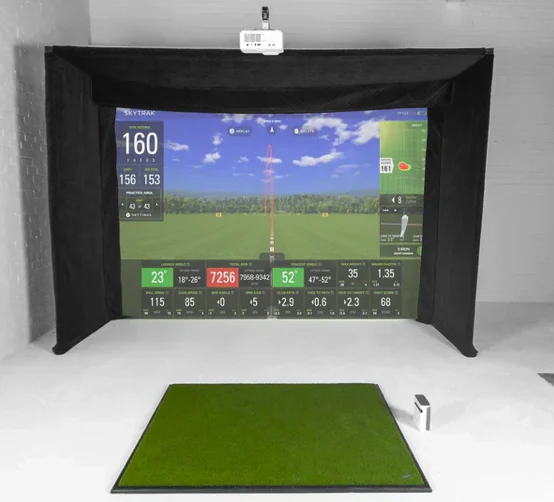
With increasingly capable tracking systems, realistic simulation software and complete golf simulators for sale, golfers can create practice environments that suit garages, garden rooms, spare rooms and dedicated indoor spaces.
The attraction is not simply being able to play golf indoors. The real value lies in having a practice facility that is available whenever it is needed.
Practice Without Depending on the Weather
British golfers are used to adjusting their plans around the weather.
Rain, strong winds, frost and short winter days can all disrupt a regular practice routine. Even when a driving range remains open, finding the motivation to practise on a cold evening is not always easy.
An indoor golf setup removes much of that uncertainty.
Instead of checking the forecast before planning a range session, players can practise at home regardless of conditions outside. That makes it easier to maintain a routine during autumn and winter and can help golfers avoid the long breaks that often lead to inconsistency.
The ability to practise after work is another major advantage.
A golfer may not have enough daylight for nine holes, but 30 minutes of structured indoor practice can still be highly productive. Over the course of several months, those shorter sessions can add up to a substantial amount of extra training.
Better Feedback Creates Better Practice
One of the biggest differences between traditional practice and modern indoor golf is the quality of feedback available after every shot.

At a driving range, golfers can see the ball fly, but judging exactly what happened is not always easy. Range balls can behave differently from premium golf balls, weather influences the flight and distance markers are not always precise.
A launch monitor provides a much clearer picture.
Depending on the technology being used, golfers can monitor measurements such as ball speed, launch angle, carry distance, spin rate and shot direction. More advanced systems can also provide detailed information about the club at impact.
Equipment such as the Protee VX launch monitor is designed to capture shot information that can help golfers understand why the ball is producing a particular flight.
That information can make practice more purposeful.
Instead of thinking that a shot “felt good”, a golfer can compare the actual numbers. If a driver is launching too low, the data may confirm it. If an iron shot is spinning more than expected, the player can begin investigating the reason.
Numbers do not replace coaching, but they provide useful evidence.
Focus on Patterns Rather Than Individual Shots
Golfers often place too much importance on a single good or bad shot.
One perfect drive can create the impression that a swing change is working, while one poor iron shot can make a player abandon an adjustment too quickly.
Indoor practice makes it easier to look at patterns.
A golfer might hit 20 shots with a 7-iron and assess the average carry distance, dispersion and consistency rather than focusing on the longest shot.
This can provide a far more realistic picture of performance.
The same approach can be used with the driver. Instead of chasing maximum ball speed, players can look at how frequently the ball finishes within a target area.
For many amateur golfers, reducing dispersion is more valuable than finding an extra few yards.
Improve Distance Control With Wedges
Wedge practice is one area where a home setup can be particularly useful.
Many golfers have a reasonable idea of their full-swing distances but much less confidence from shorter ranges.
Shots from 40, 50, 60 and 70 yards often require partial swings, and these can be difficult to practise consistently on a traditional range.
With accurate shot measurement, players can build a simple distance system.
For example, they might use three different swing lengths with two or three wedges and record the average carry distance of each.
Over time, this creates a set of reliable numbers that can be used on the course.
Instead of standing over a 65-yard shot and guessing how hard to swing, the golfer has already practised that distance repeatedly.
That kind of preparation can make a noticeable difference to scoring.
A Home Setup Encourages Shorter, More Frequent Sessions
Long practice sessions are not always the most productive.
After hitting a large number of balls, fatigue can begin to affect technique and concentration. Golfers may continue swinging without having a clear objective simply because there are balls left in the basket.
Home practice offers a different approach.
Because the facility is always available, there is less pressure to fit everything into one session.
A golfer can spend 20 minutes working on one specific skill, stop, and return the following day.
For example, a weekly practice routine might include:
- One session focused on wedge distances
- One session measuring iron dispersion
- One session working on driver accuracy
- One virtual round to practise decision-making
The total practice time does not need to be enormous. Consistency is more important.
Choosing the Right Space
Before investing in indoor golf equipment, golfers should carefully assess the space available.
Ceiling height is one of the first considerations. Players need enough clearance to make a full swing comfortably without worrying about hitting the ceiling or nearby objects.
Room width also matters, particularly if both right- and left-handed golfers will use the setup.
Depth requirements vary depending on the tracking system and screen arrangement.
Some technologies can operate within relatively compact rooms, while others require additional distance between the hitting position and the screen.
It is therefore sensible to plan the entire room before purchasing individual components.
A typical setup might include a hitting mat, impact screen, enclosure, launch monitor and projector. The exact combination will depend on budget, available space and whether the main priority is practice, entertainment or a mixture of both.
Virtual Golf Can Make Training More Enjoyable
One of the reasons simulator golf has become so popular is that it combines training with entertainment.
Rather than spending every session hitting shots at a virtual range, golfers can play simulated courses and challenge friends or family.
This can help keep practice interesting.
Virtual rounds also require golfers to change clubs regularly, select targets and respond to different distances.
That creates a more varied experience than simply hitting the same club repeatedly.
Although a simulated course cannot perfectly reproduce uneven lies, changing weather or the feel of real greens, it can still encourage better decision-making and provide useful shot practice.
Technology Should Support the Golfer
There is a temptation to become obsessed with data when using modern golf technology.
Players can sometimes spend more time studying numbers than actually improving their technique.
The most useful approach is to identify a small number of measurements that relate directly to the golfer’s goals.
Someone working on driver consistency may concentrate on carry distance and dispersion. A player trying to improve wedge control may focus almost entirely on carry numbers.
More data is not automatically better.
Technology works best when it helps answer a specific question about performance.
A More Convenient Route to Better Golf
Home golf is not intended to replace playing outdoors.
Golfers still need experience on real courses, where they must deal with slopes, rough, bunkers, wind, course management and the pressure of scoring.
What indoor technology provides is a convenient way to prepare for those situations.
It allows players to practise more regularly, monitor progress and develop a clearer understanding of their own game.
For golfers who struggle to find time for frequent range visits, that accessibility may be the biggest benefit of all.
A well-designed home golf space can turn an unused room or garage into a year-round practice facility, making it easier to keep the swing active and approach every session with a genuine purpose.