
The crypto market acts on emotions, unlike the conventional stock markets. A trader who sees their holdings of bitcoin rise by 10% within an hour will act differently from someone who has a slow-mover in an index fund. And the behavioral differences form the cycles of the market.
In the crypto world, this trend applies to everyone, from the individual trader to those who run trading bots. The same trend is evident on the crypto casino platform, which features the same swift price movements and feedback mechanisms. Knowing why traders react this way helps one understand the rallies and crashes of crypto in the past.
What the Fear and Greed Index Actually Measures
The Crypto Fear and Greed Index is used to measure market sentiment on a scale of 0-100, with 0 meaning extremely fearful and 100 being extremely greedy. This index uses a number of indicators such as volatility, trading volume, Bitcoin dominance, social media activity, and search trends to create one consolidated number.
Once the indicator rises above 75, confidence usually turns into overconfidence. There are quick gains, hype starts spreading on social media, and traders begin chasing everything that seems profitable. The reverse occurs when there is an extremely fearful situation, when the indicator drops below 25.
Why FOMO and FUD Drive So Many Decisions
In a Kraken survey of 1,248 crypto holders, 84 percent said they had made investment decisions because of FOMO, and 81 percent confessed to making decisions because of FUD (fear, uncertainty, and doubt). Therefore, a significant proportion of trading is driven by emotions in response to changes in price and online discourse rather than by analysis.
A few behavioral patterns show up consistently across market cycles:
- Buying near local price peaks driven by social media hype and FOMO.
- Panic selling during sharp drops, often locking in losses that later reverse.
- Overreacting to single headlines instead of weighing broader context.
- Following influencer price predictions rather than independent research.
- Holding losing positions too long out of reluctance to admit a mistake.
In particular, retail traders tend to trade based on price momentum and not create it. In times of greed, money is poured into meme coins and altcoins for the purpose of making high profits. In times of fear, the same retail traders sell out of volatile investments and invest in stablecoins.
How Sentiment Data Gets Used in Practice
Traders who follow both sentiment indicators and price charts see extreme values as an alert for increased focus, but not as a direct indication for buying or selling. The index performs better in combination with other information than alone. Here are some useful applications of sentiment indicators:
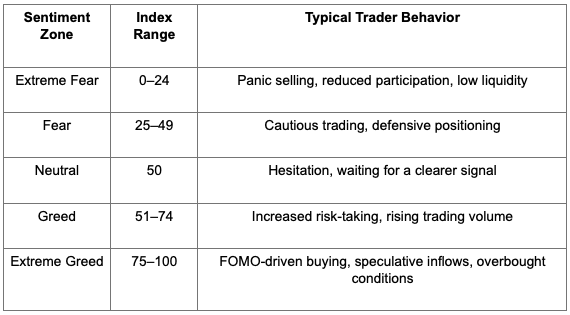
The index itself does not give any indication of what will happen next in terms of price action. The real value that it provides is that it shows just how much of a given price move is due to sentiment as opposed to fundamental drivers.