

The team sheet drops about an hour before kick-off, and for a certain kind of supporter it is the most important hour of the day. The line-ups land, group chats light up, and a match that felt settled on paper suddenly looks different. A rested striker is back. A first-choice centre-half is only on the bench. The shape has quietly changed. Long before the whistle, eleven names and a row of substitutes have already told a story, if you know how to read them.
Most fans scan for their favourites and move on. Analysts read the sheet the way a chess player reads an opening, not as a list but as a set of intentions. Here is how to get more out of those two columns than a quick glance gives you.
The starting XI: rotation or full strength
The first question a team sheet answers is how much a manager cares about this particular fixture. A full-strength side in a midweek cup tie says one thing; five changes before a bigger league game three days later says another. Rotation is not laziness, it is resource management across a congested calendar, and spotting it early reframes the whole preview.
Look for the spine. If the goalkeeper, the main centre-back pairing, the deepest midfielder and the leading striker all start, the manager is treating the match as a priority regardless of who fills the wide areas. When two or three of those anchor positions are rested, the result matters less to them than the fixture that follows.
Reading the bench
The substitutes’ list is where squad depth becomes visible. A bench stacked with senior internationals is a different threat in the last twenty minutes than one padded with academy names to fill the seats. It tells you what a manager can do if the game turns, and how much they trust the players holding it together at one-nil.
Watch, too, for the marquee name left among the subs. A star on the bench is rarely a snub; it is usually load management, a knock being protected, or a plan to change the game after the hour. The latest news around a club in the days before kick-off, the fitness updates and press-conference hints, usually explains a benching that looks surprising in isolation.
Formation clues hidden in the names
You cannot always read a shape straight from a team sheet, but you can narrow it down. Two recognised full-backs and a lone striker point toward a back four and a controlled game. Three centre-backs suggest wing-backs and width from deep. An extra midfielder in place of a forward is a manager telling you, before a ball is kicked, that they intend to control the middle rather than trade chances.
Reference points help here. Knowing the standard formations in football and what each is built to do turns a list of names into a plausible tactical picture. A 4-3-3 and a 3-5-2 can share nine of the same players and still play utterly different matches.
What the sheet signals, at a glance
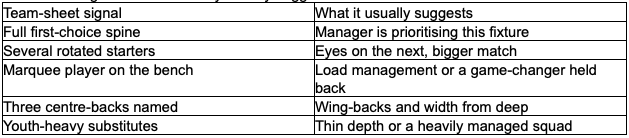
None of these reads is a guarantee. They are leans, not locks. The table pairs common team-sheet signals with what they usually suggest.
What a team sheet cannot tell you
Here is the honest limit. A team sheet frames the match; it does not decide it. It cannot show you the tactical tweak whispered at half-time, the red card that reshapes an hour, or the substitute who scores against the run of play. The best-drilled preview in the world still bends to ninety minutes of a chaotic game. Read the sheet to understand the plan, not to predict the score, because no line-up has ever been a result.
The second-screen match night
Reading a team sheet is part of a wider shift in how supporters watch. Match nights are increasingly second-screen affairs, with stats, group chats and live entertainment sharing attention with the pitch. For readers who fill that downtime with a stream of their own, the live-dealer format on Shuffle’s bitcoin casino live dealers pages is one such option, best treated as paid entertainment rather than a way to beat the night. Gambling involves risk. 18+. Play responsibly.

Whatever fills the breaks, the pleasure of the hour before kick-off stays the same: two columns of names, and a story you can read before anyone has touched the ball.
Frequently Asked Questions
Why is the team sheet released an hour before kick-off?
Competition rules require line-ups to be submitted to officials and published around 60 minutes before kick-off, giving broadcasters, opponents and fans the same window to react.
Does a rotated line-up mean a team will lose?
No. Rotation reflects priorities across a busy schedule, not a weaker effort. A rotated side is often still deep enough to win; it simply signals where the fixture sits in the manager’s plans.
Can you tell the exact formation from a team sheet?
Not exactly, but you can narrow it down. The balance of defenders, midfielders and forwards named points toward a likely shape, even if the final positioning only becomes clear once play starts.
What does a big-name substitute usually mean?
Most often load management or a minor knock being protected, or a deliberate plan to change the game later. The club’s build-up news usually clarifies which.