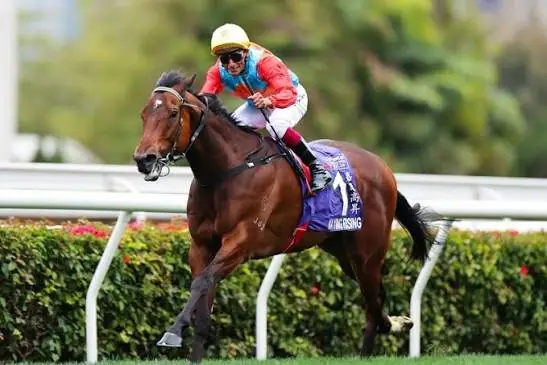
Ka Ying Rising has completed his journey from Hong Kong to Sydney in considerably better condition than he did before winning last year’s Everest, prompting trainer David Hayes to declare the world’s highest-rated sprinter may have improved by at least 10 per cent ahead of his title defence at Royal Randwick.
The six-year-old arrived at Canterbury Park’s international quarantine centre on Monday following an approximately 16-hour journey from Hayes’ Sha Tin stable.
Ka Ying Rising lost only five kilograms during the trip, maintained his appetite and recorded a normal temperature before completing gentle exercise around Canterbury on Tuesday morning.
The initial signs encouraged Hayes and the veterinary team responsible for managing one of international racing’s most valuable horses.
“I was just talking to my vet, and she said she really thinks he handled it better than he did last year,” Hayes said, according to Racenet.
That comparison should concern every Australian trainer attempting to defeat the reigning Everest champion.
Last year’s version travelled well enough to win the $20 million race.
Hayes believes the horse standing inside Canterbury’s quarantine facility is bigger, stronger and considerably more experienced.
Ka Ying Rising Lost Only Five Kilograms
International travel can affect horses in ways that are not immediately visible.
The flight itself represents only part of the challenge. Horses must also contend with transport between stables and airports, quarantine requirements, changes in routine and long periods spent inside unfamiliar surroundings.
Weight loss, dehydration, an elevated temperature or a reduced appetite could each interrupt Ka Ying Rising’s preparation.
None has emerged following his arrival.

The gelding travelled to Sydney heavier than he did in 2025 and dropped only five kilograms during transit.
His appetite remained strong enough for him to begin eating grass shortly after reaching Canterbury—a novelty for a racehorse accustomed to Hong Kong’s highly controlled Sha Tin environment.
Hayes revealed that Ka Ying Rising nearly pulled his handler towards the grass upon arrival.
That behaviour provides no guarantee of another Everest victory, but it indicates the trip did not leave him exhausted or distressed.
The horse’s physical condition can also be monitored against information collected during last year’s campaign, giving Hayes an immediate understanding of whether he has travelled normally.
That experience removes much of the uncertainty that surrounded Ka Ying Rising’s first Australian visit.
Hayes Believes He Has Improved by at Least 10 Per Cent
Hayes has never been reluctant to express confidence in his champion, but his latest assessment is still extraordinary.
“I say conservatively he is 10 percent better than last year,” he said.
Quantifying a horse’s improvement with an exact percentage is subjective. There is no single measurement capable of proving Ka Ying Rising has progressed by precisely 10 per cent.
However, Hayes’ conclusion is supported by several physical and performance indicators.
Ka Ying Rising returned to racing heavier and more developed before winning the Group 3 HKSAR Chief Executive’s Cup at Sha Tin earlier this month.
Despite carrying 61 kilograms and entering the race above what Hayes considered his ideal racing weight, the gelding defeated Copartner Prance by seven-and-three-quarter lengths.
He completed the 1200 metres in 1:06.11, lowering his own Sha Tin course record by almost one second.
It was the fifth occasion Ka Ying Rising had broken the track’s 1200-metre record.
The victory extended his winning sequence to 21 races and improved his overall record to 22 wins and two seconds from 24 starts.
Hayes is not merely judging his horse through optimism.
Ka Ying Rising has returned heavier, travelled with less weight loss and produced the fastest performance of his career before leaving Hong Kong.
Last Year’s Problems Were Mostly Self-Inflicted
Ka Ying Rising won the 2025 Everest, but his preparation was far from straightforward.
Hayes later acknowledged that he allowed the gelding to arrive in Sydney too fresh.
Ka Ying Rising became agitated during his public appearance at Randwick and delivered a barrier-trial performance that fell considerably short of public expectations.
That hit-out triggered widespread speculation about his condition.
His price eased with bookmakers, rumours circulated that he could be withdrawn and Hayes spent much of the following period attempting to reassure punters that the horse remained healthy.
Ka Ying Rising ultimately defeated Tempted and Jimmysstar on race day, proving the trial result had exaggerated the concerns.
Hayes has adjusted the preparation this year.
The gelding completed more foundation work before travelling and arrived with a greater fitness base, reducing the risk that he will become excessively fresh during his Canterbury stay.
His slow work will be gradually lengthened ahead of an expected Randwick trial on October 6.
The objective is not necessarily to produce an impressive trial victory.
Hayes wants Ka Ying Rising mentally settled, physically stimulated and prepared to peak in The Everest 11 days later.
Canterbury Is Now a Familiar Environment
Ka Ying Rising will spend approximately two weeks at Canterbury before completing his final preparations for the October 17 Everest.
Returning to the same quarantine facility provides an important advantage.
Hayes already understands how the horse responds to the track, stabling and daily routine.
Ka Ying Rising also demonstrated during his previous visit that he could eat, recover and maintain his condition inside the Canterbury environment.
Those may appear like routine details, but they can become decisive when preparing an international horse for a 1200-metre race decided by fractions of a second.
Ka Ying Rising does not need to learn where he is.
The team does not need to experiment with a new training pattern or discover how he reacts to the facilities.
Hayes can make smaller adjustments based upon last year’s successful campaign rather than constructing the entire preparation without a reference point.
Retired Half-Brother Has Important Travelling Role
Ka Ying Rising did not make the journey alone.
His retired half-brother Ka Ying Glory travelled with him and will remain his companion throughout the Australian campaign.
Ka Ying Glory suffered a tendon injury and has been retired from racing, but Hayes believes his presence provides important mental support.
Travel companions can help valuable racehorses remain calm, eat normally and settle into unfamiliar surroundings.
Ka Ying Cheer performed the same role during Ka Ying Rising’s previous visit.
The arrangement is another example of how carefully the Hong Kong champion’s campaign has been planned.
Ka Ying Glory has no competitive responsibility.
His job is to remain beside Ka Ying Rising and provide familiarity while the defending champion is separated from the wider stable environment he knows at Sha Tin.
For a horse whose ability to remain mentally relaxed became a major talking point last year, that role should not be underestimated.
Private Boeing 747 Highlights Scale of Operation
Ka Ying Rising’s return journey demonstrates the enormous financial and logistical commitment surrounding his campaign.
A private Boeing 747 has reportedly been chartered to transport him back to Hong Kong two days after The Everest.
The arrangement will allow the champion to leave Australia quickly, reduce uncertainty around his return travel and settle back into his Sha Tin routine.
Hiring a private aircraft for one racehorse illustrates how valuable Ka Ying Rising has become to Hong Kong racing.
He is not simply another international visitor.
He is the jurisdiction’s headline horse, a record-breaking champion and one of the most recognisable thoroughbreds competing anywhere in the world.
Every element of the trip—from his companion horse to his exercise schedule and return flight—has been designed to reduce risk.
That does not eliminate the unpredictable nature of international racing.
It does give Hayes every opportunity to present Ka Ying Rising in peak condition.
Australian Opposition Remains Uncertain
Ka Ying Rising has arrived before much of the 2026 Everest field has been finalised.
At the time of his arrival, Michael Freedman’s sprinter Ninja was the only other horse officially confirmed for the race.
Tempted, Joliestar and emerging three-year-old Guest House are among the leading horses expected to come under consideration, while several slot holders are continuing to assess the available Australian sprinters.
The uncertainty reflects both the timing of the spring and the intimidating presence of the defending champion.
Ka Ying Rising is already an overwhelming favourite.
His record-breaking return at Sha Tin demonstrated that his prolonged winning sequence has not left him vulnerable, while his improved travel experience removes one of the few potential weaknesses rivals could identify.
That does not make the result inevitable.
Ka Ying Rising will still need to handle his Randwick trial, maintain his condition through quarantine, draw acceptably and reproduce his best under race pressure.
Australian trainers will also study last year’s Everest for tactical opportunities.
Allowing Ka Ying Rising to find his rhythm near the speed could make him almost impossible to run down.
Applying early pressure may be necessary, but challenging him too aggressively risks damaging the chances of every horse involved.
The Everest Trial Must Be Judged Properly
Ka Ying Rising’s October 6 trial will attract enormous attention.
Every stride will be analysed, particularly after last year’s performance generated such dramatic speculation.
The finishing position should again be treated cautiously.
Barrier trials are designed to prepare horses rather than prove their race fitness, and Hayes will not want Ka Ying Rising producing his maximum effort 11 days before a $20 million target.
His behaviour before the trial, the way he travels through the hit-out and his recovery will reveal more than whether he crosses the line first.
Hayes now understands how much work the horse requires between the trial and race day.
That knowledge should prevent another anxious fortnight dominated by rumours about the champion’s condition.
Ka Ying Rising Has Already Passed His First Test
The most dangerous stage of an international campaign can occur before the horse reaches the racetrack.
Ka Ying Rising had to complete quarantine, endure the long journey from Sha Tin and settle into a different environment without losing condition.
He appears to have passed each part of that test.
The five-kilogram weight loss is manageable, his appetite remains healthy and his veterinary readings have provided no cause for alarm.
Hayes’ prediction that he is at least 10 per cent better cannot be confirmed until the gates open at Randwick.
What can be established is that Ka Ying Rising has arrived in better shape, with a more suitable fitness base and considerably more experience than he possessed before his first Everest.
Last year, he survived an imperfect preparation and still defeated Australia’s best sprinters.
This time, the preparation has begun almost exactly as Hayes intended.