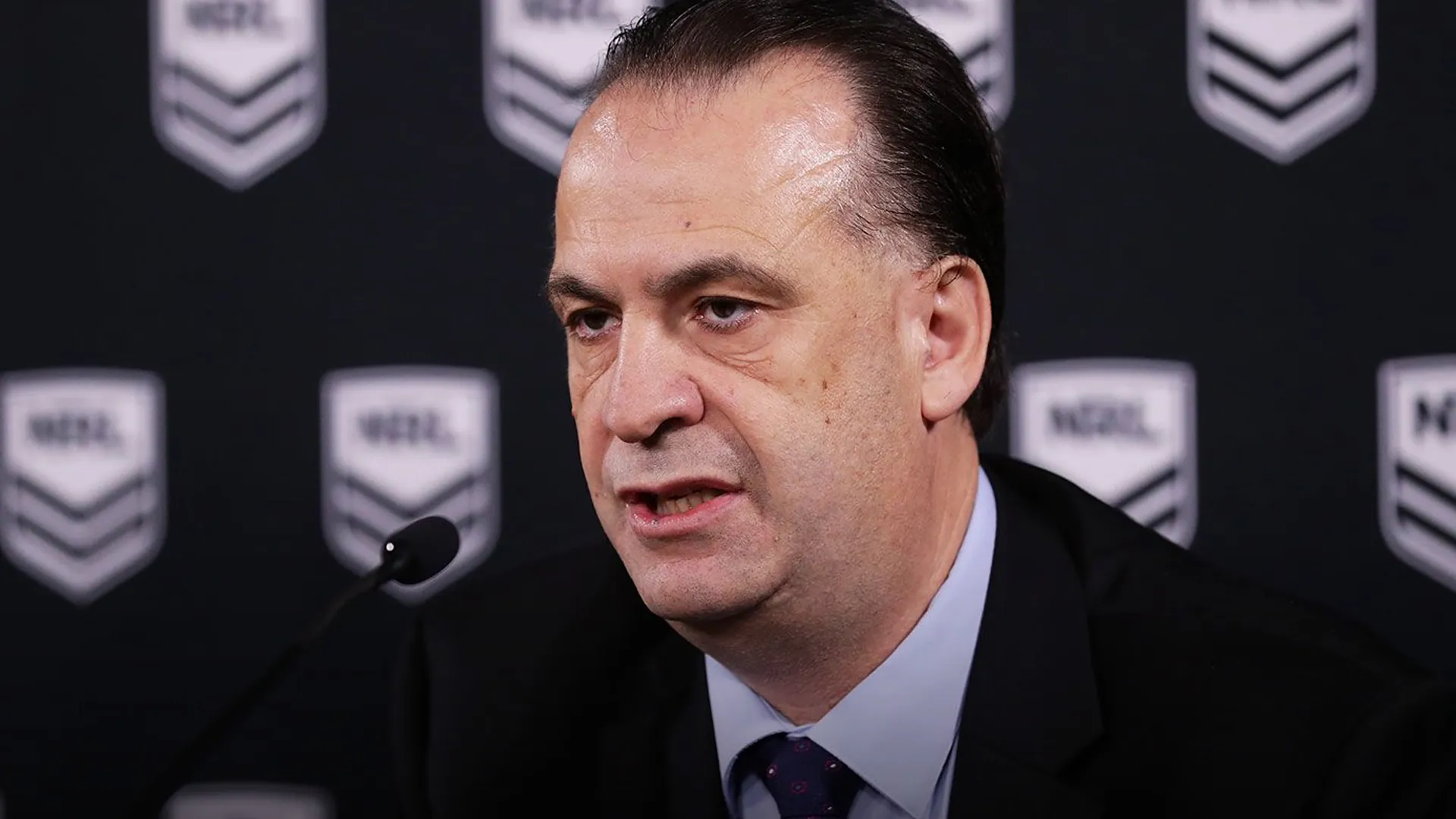
Peter V’landys has built his reputation on finding new audiences and new revenue, but the NRL’s reported third-place playoff proposal risks turning grand final week into a meaningless cash grab.
The league is considering staging a match between the two losing preliminary finalists, borrowing the concept from football’s World Cup.
On paper, it delivers another premium television fixture. In reality, it would ask two physically exhausted and emotionally shattered teams to play a match with no meaningful prize.
One important factual distinction must be made: reports confirm the NRL is considering the concept, but V’landys has not publicly declared that he personally wants it introduced. The proposal was reportedly inspired by a club chief executive after the third-place playoff at the FIFA World Cup.
The plan was detailed as part of Fox Sports’ latest NRL news coverage.
Regardless of who first floated it, the Commission should abandon it.
Third place means nothing in the NRL
NRL teams do not spend an entire season attempting to finish third.
They compete to win a premiership.
A preliminary-final defeat is devastating because it ends that pursuit one victory short of the grand final. Asking those players to recover within days and manufacture enthusiasm for a third-place playoff misunderstands what makes the finals compelling.
Every existing finals match has a clear consequence. Win and advance. Lose and the season is over.
A third-place playoff breaks that simple formula. Both teams would enter knowing their premiership hopes were already gone.
The winning club would receive a manufactured accolade that has never carried any historical significance in Australian rugby league. The losing team would simply suffer another defeat after its season had effectively ended.

Can anyone seriously imagine supporters proudly celebrating a “third-place championship”?
Players would have little reason to take the risk
Canterbury veteran Kurt Mann has already explained why the proposal would be difficult for players to embrace.
“If it doesn’t mean anything then I reckon you’re better off just leaving it there,” Mann said.
“It’s a big emotional rollercoaster, and usually when you have a massive emotional high and then you have the big comedown—which would be losing a preliminary final—the likelihood of getting injured or something going on in those next games is pretty high.”
That is the strongest argument against the concept.
Rugby league players already complete a gruelling regular season, potentially three weeks of finals and, for the competition’s elite, State of Origin and international commitments.
The 2026 season also leads directly into the Rugby League World Cup.
Why should players risk surgery, rehabilitation or even their availability for international selection in a match that does not affect the premiership?
The Rugby League Players’ Association had reportedly not received a formal proposal when the idea emerged. It has instead supported placing a rest week between the preliminary finals and the grand final.
That position is consistent with the RLPA’s existing concerns about player workload and injury risk, with the association previously challenging the NRL over rule changes affecting fatigue and safety.
Clubs would almost certainly rest their stars
Even if the NRL offered substantial prizemoney, coaches would face a straightforward decision.
Why risk an injured superstar in a game that cannot deliver a premiership?
Players carrying shoulder, knee and ankle injuries would likely be sent for surgery immediately after the preliminary final. Representative stars could be withdrawn to prepare for international football. Off-contract players might decide that protecting their next contract is more important than competing for third place.
The result could be two dramatically weakened teams playing what is advertised as a marquee grand final-week fixture.
That creates a problem for supporters and broadcasters.
If the best players are absent and the intensity resembles a preseason trial, the match would quickly become exactly what its critics expect: content for the sake of content.
The NRL could attempt to make participation compulsory, but it cannot force injured players onto the field or prevent clubs from selecting younger squad members.
The World Cup comparison does not work
Third-place playoffs exist at the FIFA World Cup because international tournaments operate differently from domestic rugby league competitions.
A World Cup is held every four years and involves countries travelling to one host nation for a self-contained tournament. The third-place game provides another opportunity for teams and supporters who have already made that journey.
It also determines an official final ranking at one of world sport’s biggest events.
The NRL already has a 27-round regular season followed by a four-week finals series. The competition does not require another match to determine whether a preliminary-final loser should finish third or fourth.
Regular-season ladder position could already separate the two teams if such a ranking were genuinely necessary.
Copying an idea simply because it produced an entertaining football score does not mean it suits rugby league.
Grand final week does not need another men’s game
There are better ways to strengthen grand final week without asking disappointed teams to play again.
The NRL could invest more heavily in fan events, junior competitions, community programs, awards, club activations and the women’s game.
Grand final day already provides an opportunity to showcase the NRLW decider and emerging talent. Those matches carry genuine trophies and genuine emotional stakes.
Giving those competitions greater promotion would add substance to the week without creating a consolation fixture.
The league also has the financial capacity to think beyond another broadcast product after securing its record seven-year media agreement reportedly worth $5.3 billion.
That money should reduce the temptation to extract revenue from every available space in the calendar.
Expansion already creates more content
The NRL does not have a shortage of matches.
The Perth Bears will enter the competition in 2027, followed by the PNG Chiefs in 2028. Those additions will create more regular-season fixtures and expand the league’s audience.
V’landys is also pushing ahead with plans for a Global Round involving matches in markets such as Las Vegas, Tokyo, Hong Kong and England.
The Sporting Base has already examined how the NRL plans to spend its record broadcast windfall, with expansion, player payments, grassroots investment and international growth among the major priorities.
Adding a third-place final on top of those ambitions feels unnecessary.
V’landys deserves credit for refusing to let rugby league stand still. Las Vegas, expansion and the record broadcast deal demonstrate the value of commercial ambition.
But innovation is not automatically improvement.
A match without meaningful stakes, supported by exhausted players and potentially contested by weakened teams would not enhance grand final week. It would dilute the brutal simplicity that makes the NRL finals so compelling.
Win and keep playing. Lose and go home.
The game does not need to be more complicated than that.
MORE NRL NEWS: View Our NRL News Here