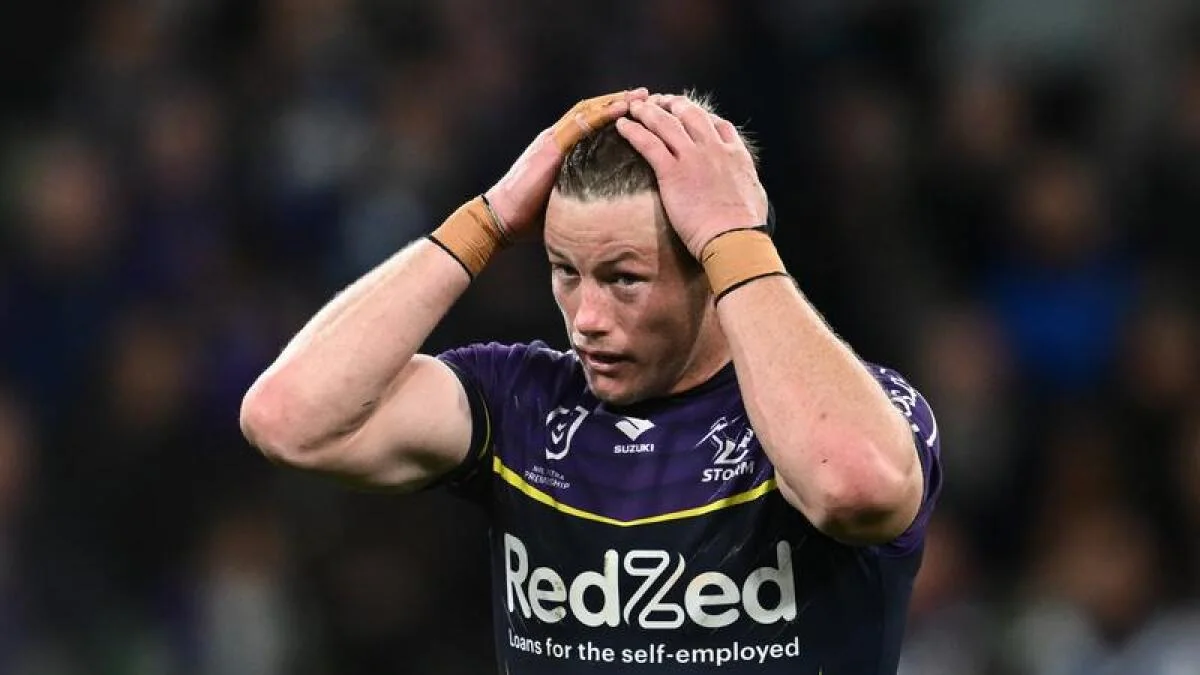
Harry Grant has delivered a blunt verdict on the NRL’s controversial kick-off experiment, declaring the traditional restart is part of rugby league’s fabric and does not need to change.
The Storm captain became the first player to use the new option during Melbourne’s 46-20 victory over Brisbane at Suncorp Stadium.
Under the trial, the team that concedes points can choose whether to receive the ensuing kick-off or kick the ball back to its opponent.
The rule was designed to prevent one team dominating possession and producing an avalanche of points, but its first appearance provided little evidence that it would reduce blowouts.
Melbourne still scored eight tries and won by 26 points.
Grant Tells NRL to Leave the Game Alone
Grant was already unconvinced by the proposal before the match and remained firmly opposed after experiencing it.
“Personally I love the game. I’ve loved the game for so many years since I was four years old,” Grant said.
“I think it’s part of the fabric of the game and we don’t need to change it.
“We’re bringing in a rule to counteract the rules we’ve brought in.
“Maybe we can have a deep, hard look at going back on a few rules if that’s where we sit with it.”
Grant’s criticism goes beyond disliking one experimental restart.
He believes the NRL may be creating additional rules to correct problems caused by previous changes instead of reconsidering whether those earlier changes remain necessary.

“There’s no real reward for it and I’m pretty strong on that,” he said.
“I think there are a lot of people in the game strong on it and maybe it’s time to stay with what it is.”
Storm Made History While Playing With 12 Men
The rule was barely relevant throughout the first half despite Melbourne building a commanding 30-10 lead.
Brisbane repeatedly chose to kick off after conceding, even as the Storm established complete control of the contest.
Its historic first use came after Ben Hunt scored in the 50th minute while Melbourne winger Moses Leo was in the sin bin.
With his team temporarily reduced to 12 players, Grant elected to receive the restart rather than immediately defend another Broncos possession.
Melbourne regained the ball from the kick-off, making Grant the first captain to successfully use the option in an NRL premiership match.
The Storm used it again late in the contest but dropped the restart, immediately returning possession to Brisbane.
Those two moments demonstrated the tactical possibilities and the risks involved, but neither significantly affected the result.
Munster Wants Rugby League to Preserve Its Identity
Cameron Munster also questioned the need to continually alter the sport’s central features.
The Storm five-eighth argued that scoring, kicking off and defending the next set have always been fundamental parts of rugby league.
His opposition reflects the broader concern surrounding the trial: the proposed change does not simply modify how a technical infringement is punished.
It changes who receives possession after points are scored.
Under the traditional system, the team that concedes must kick off and earn the ball back through its defence. The trial can instead reward that team with immediate possession after it has just allowed points.
That may interrupt scoring runs, but it also removes part of the advantage earned by the attacking team.
Broncos Refused to Use the Rule as Score Blew Out
Brisbane’s approach exposed the biggest problem with the NRL’s reasoning.
The Broncos conceded three consecutive tries as Melbourne established a 24-4 lead, yet they continued kicking off instead of choosing to receive.
If the rule was introduced to stop one-sided momentum, this was precisely the scenario in which it was supposed to help.
Brisbane still did not use it.
The Broncos may have preferred the territorial advantage of kicking deep, believed their short restart presented a better attacking opportunity or simply felt more comfortable following the game’s traditional structure.
Whatever the reason, a team being comprehensively outplayed cannot be forced to use the option.
The NRL can give struggling sides a choice, but it cannot guarantee that choice will make matches closer.
Hunt and Maguire Join Opposition
Ben Hunt was equally direct after Brisbane’s defeat.
“No mate, not a fan,” Hunt said.
“I don’t know why we keep trying to change the rules of our game.”
Broncos coach Michael Maguire supported that position despite watching his team concede 46 points.
“I do like the game the way it is,” Maguire said.
“It’s a great game, so you don’t need to tinker too far, especially the way the game’s going at the moment.”
Craig Bellamy was also lukewarm before the match, describing Broncos-Storm as a suitable fixture for the experiment only because neither team could reach the finals.
That hardly represents an enthusiastic endorsement.
The first trial therefore ended with the captains and coaches from both clubs questioning whether the rule should exist.
New Rule Creates Unnecessary Confusion
Another problem emerged over when the captain must announce the decision.
Teams were reportedly required to indicate whether they would kick or receive shortly after the try rather than waiting for the conversion attempt to be completed.
That timing matters.
A captain chasing a six-point deficit could make one decision if the conversion is successful and another if the attempt misses. Requiring an immediate answer removes information that could materially affect the correct tactical choice.
Coaches would also inevitably develop signals to communicate their preferred option through trainers or players, despite early suggestions the captain would make the decision independently.
Rather than simplifying rugby league, the rule introduces another strategic process that spectators, officials and players must interpret after every score.
First Trial Failed to Justify Permanent Change
The NRL deserves some credit for testing the proposal before introducing it permanently.
The ARL Commission decided in February not to implement the change during the 2026 season after clubs and other stakeholders raised concerns. It instead approved limited trials in matches without finals consequences.
That was a more responsible approach than imposing the rule without seeing it operate at NRL level.
However, the first experiment strengthened the case against it.
Brisbane did not use the option while Melbourne’s lead expanded, the match still became a blowout and the players involved overwhelmingly preferred the traditional arrangement.
Rugby league should not resist every innovation simply because it is unfamiliar.
But a rule change this significant requires compelling evidence that it will improve the sport.
The Broncos-Storm trial supplied none.
Grant became the first captain to use the new option and still walked away believing it should disappear.
The NRL should listen.
MORE NRL NEWS: View Our NRL News Here