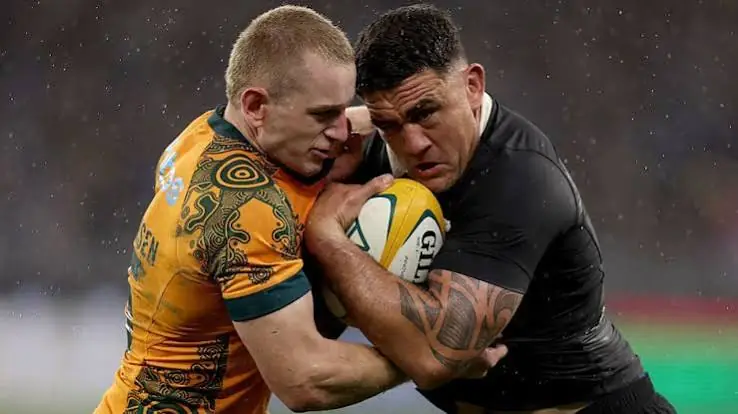
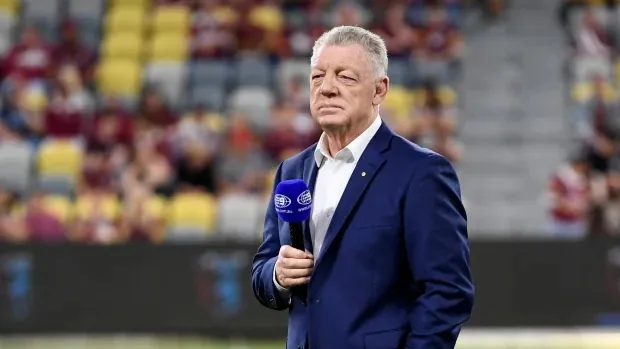
Phil Gould has offered the NRL a far more compelling alternative to Peter V’landys’ controversial third-place playoff—but would clubs and players embrace an entirely new competition?
Instead of forcing two shattered preliminary-final losers back onto the field, Gould has floated reviving a knockout tournament for teams that miss the top eight.
The concept remains only an idea. No formal proposal, format or prize-money structure has been submitted or approved by the NRL.
V’landys wants more football during grand final week
V’landys recently proposed staging a playoff between the two losing preliminary finalists during the week leading into the NRL Grand Final.
The ARL Commission chairman believes the NRL should capitalise on the relatively clear sporting calendar following the conclusion of the AFL season.
“Last year in grand final week it was obvious to me that there was a gap,” V’landys said.
“On Thursday night I didn’t know what to do, same on Friday and Saturday night.
“I’m thinking to myself, ‘Why haven’t we got some rugby league on?’ and a third against fourth game is worth exploring.”
V’landys said “massive prizemoney” could be offered to the participating clubs and players, with revenue from the match shared among them.
“My point as a sporting administrator is, why not take advantage of clean air?” he said.
“You’re probably going to get more viewers because there’s nothing else on, and to me that’s an idea worth exploring.”
The problem is that the players required to participate would have just lost preliminary finals and seen their premiership ambitions disappear.

As we previously argued, the NRL’s third-place playoff risks becoming a meaningless cash grab.
Players reject third-place proposal
The reaction from players has been overwhelmingly negative.
Former premiership-winning halfback Luke Keary reportedly labelled it “the worst idea ever in the game”, while Roosters winger Mark Nawaqanitawase questioned whether players would want to continue training after being eliminated.
“Honestly, if you lose, the boys probably want to get on Mad Monday,” Nawaqanitawase said.
“I don’t think it works.”
Bulldogs forward Kurt Mann also raised concerns about placing players back into a high-intensity match immediately after an emotionally draining defeat.
“The likelihood of getting injured or something going on in those next games is pretty high,” Mann said.
“If there’s nothing in it for us, then it probably doesn’t need to happen.”
Rugby League Players Association chief executive Clint Newton has said he “highly doubts” the union would support the idea.
Gould looks to the Endeavour Cup
Speaking on Nine’s 100% Footy, Gould pointed to the Endeavour Cup as a possible source of inspiration.
During the early 1970s, teams that missed the main finals competed in a separate knockout tournament at Cronulla.
“You kids were too young, but back in 1970-71 it was only a top-four finals competition back in those days,” Gould said.
“The next four teams played in a knockout competition called the Endeavour Cup down at Cronulla.
“They actually used that competition to experiment with new rules for the following year. It’s where the six-tackle rule came from, in that particular competition.”
Gould suggested a similar tournament could give players from non-finals teams valuable matches before international selection.
That is particularly relevant during a World Cup year, when players whose clubs miss the finals can go several weeks without playing before representative squads are selected.
“I think football for teams who don’t make the eight just might be the incentive where players will play on because they’ve got rep football coming up,” Gould said.
“It keeps them in the picture.
“And it gives teams who have missed the eight something to look forward to, to make some cash and maybe blood some younger players and give them a run in first grade, or what have you.
“That engages all the fans across the league—the fans who have missed out on the eight, what do they do during September? It keeps them involved as well.”
How could an NRL knockout cup work?
The Nine analysis expanded Gould’s general idea into a hypothetical four-week tournament for the 10 clubs that would miss the finals once the competition grows to 18 teams.
Under that model, the lowest four clubs would play qualifying matches before the remaining teams entered at the quarter-final stage. The tournament’s final could then be held during NRL grand final week.
Nine suggested $500,000 for the winning club and another $1 million to be divided among its players.
Those figures were part of Nine’s hypothetical model—not amounts proposed by Gould or confirmed by the NRL.
Gould’s idea is better—but still deeply flawed
Gould’s proposal immediately solves the biggest problem with V’landys’ plan.
Players eliminated in preliminary finals would not be asked to overcome heartbreak, continue training and risk injury in a match carrying no premiership significance.
A knockout cup would instead feature teams whose premiership campaigns had already ended. It could give younger players first-grade opportunities, keep representative hopefuls match-fit and maintain fan interest across more markets.
It would also provide broadcasters with considerably more content than one third-place playoff.
However, the player-welfare problem does not disappear—it simply moves to different clubs.
Players from struggling teams already endure a demanding regular season. Extending their campaigns by up to four weeks would be difficult to justify unless participation was voluntary and the financial rewards were substantial.
Clubs may also treat the competition as an opportunity to field development squads rather than risk established stars. That could undermine its credibility before it has a chance to build any tradition.
The NRL would also need to determine whether suspensions, salary-cap rules, player insurance and representative eligibility carried across into the new competition.
Don’t manufacture football solely for television
V’landys is correct that the NRL has an opportunity to dominate the sporting conversation during grand final week.
That does not mean every empty television window must be filled.
A third-place playoff would ask devastated players to contest a match few would genuinely care about winning. Prize money might encourage participation, but it cannot create authentic stakes.
Gould’s knockout cup at least offers clubs something tangible: a trophy, development opportunities, additional revenue and another chance to engage supporters.
It deserves consideration, particularly in World Cup seasons. But it should only proceed if the clubs and players believe it has genuine sporting value.
The NRL does not need another manufactured exhibition. If it creates a new competition, it must be something teams actually want to win.
MORE NRL NEWS: View Our NRL News Here